

Conditions: Benign Paroxysmal Positional Vertigo (BPPV)
Benign paroxysmal positional vertigo (BPPV) is the most common cause of vertigo, producing brief, intense spinning sensations triggered by changes in head position, such as rolling over in bed, lying down, or tilting the head back. It arises when tiny calcium crystals become dislodged within the inner ear's balance organs, and although episodes can be alarming and increase the risk of falls, the condition is not dangerous and is highly treatable.
What BPPV Is
BPPV is a disorder of the inner ear's balance (vestibular) system. The "benign" in its name means it is not life-threatening, "paroxysmal" means it comes in sudden short bursts, "positional" means it is brought on by changes in head position, and "vertigo" refers to the false sense that the room or one's own body is spinning. It is the single most frequent cause of vertigo seen in clinical practice, and roughly 1 in 10 people will experience it by the age of 80.
Episodes are typically short, usually lasting less than a minute, but can recur over days to weeks, and sometimes return months or years later. Because the dizziness can throw a person off balance, BPPV is an important and often underrecognized contributor to falls, especially in older adults. A broader overview of dizziness and balance problems is also available.
The Inner Ear and How BPPV Causes Symptoms
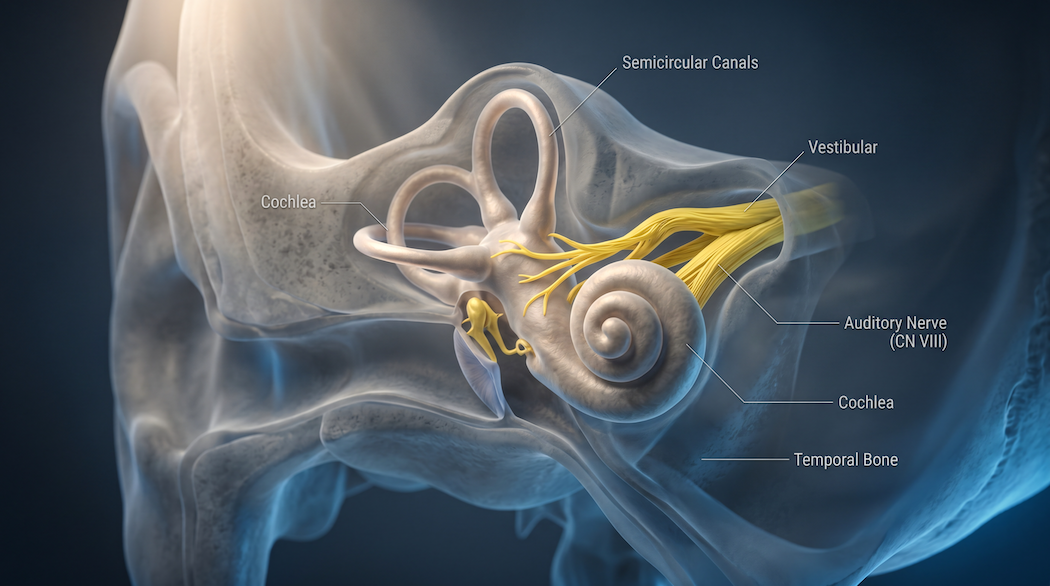
Deep within each inner ear is a set of three fluid-filled, loop-shaped tubes called the semicircular canals, which sense rotation of the head. Nearby sit the utricle and saccule, structures that detect gravity and straight-line movement using a layer of microscopic calcium carbonate crystals known as otoconia, or "ear rocks."
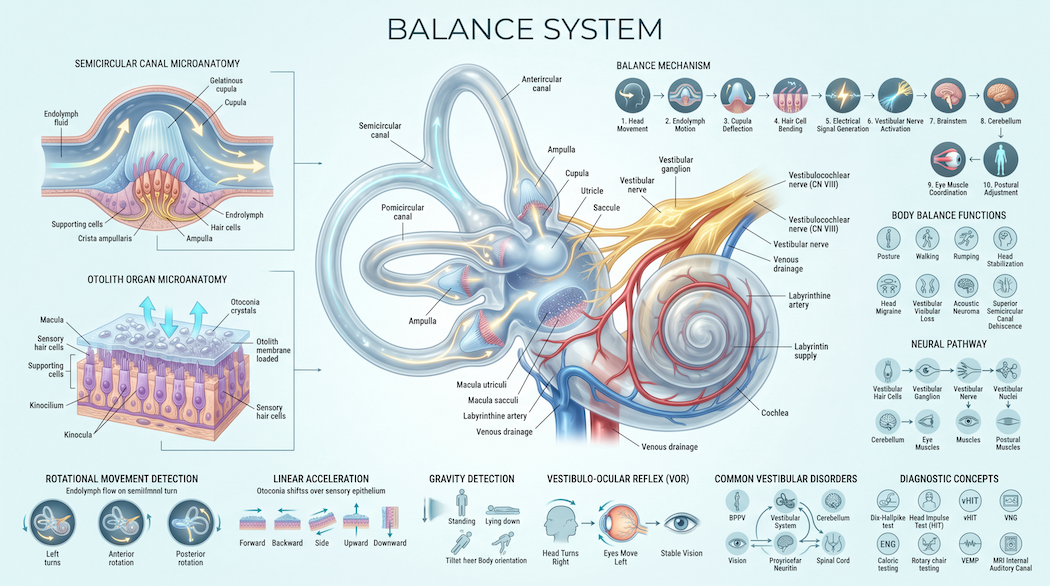
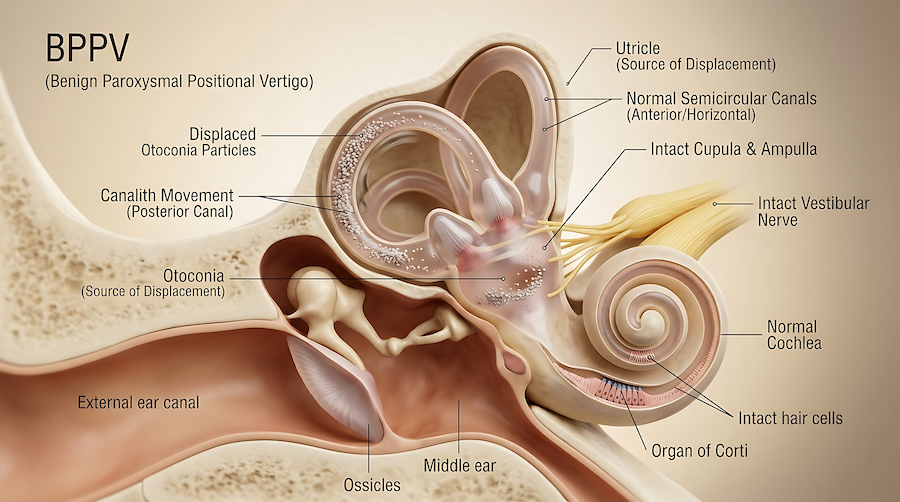
In BPPV, some of these crystals break loose from the utricle and drift into one of the semicircular canals, where they do not belong. When the head moves in the plane of the affected canal, gravity pulls the loose crystals through the canal fluid. This fluid movement bends a sensory structure called the cupula, which sends the brain a false signal that the head is spinning, even though it is not. The mismatch between this false signal and what the eyes and body actually sense produces the sensation of vertigo and triggers characteristic flickering eye movements called nystagmus. In most cases the crystals float freely in the canal fluid (canalithiasis); less often they stick to the cupula itself (cupulolithiasis), which can cause longer-lasting symptoms.
Causes and Risk Factors
In most people, no clear reason for the crystals coming loose is ever found; these cases are called idiopathic. The crystals also become more fragile and prone to dislodging with age, which is why BPPV becomes more common in older adults, with onset often peaking between the ages of 50 and 70.
When a trigger can be identified, head injury is among the most common. Other recognized associations include prolonged time lying flat (for example, during bed rest, dental procedures, or at the hair salon), and other inner ear disorders. BPPV is roughly twice as common in women as in men, and has been linked to conditions such as osteoporosis and low bone density, vitamin D deficiency, migraine, high blood pressure, diabetes, and abnormal cholesterol levels.
Typical Symptoms
The hallmark of BPPV is brief, intense spinning vertigo triggered by a change in head position relative to gravity. Common triggers include rolling over in bed, getting in or out of bed, bending forward, or tilting the head back to look up. Each spell usually lasts well under a minute, and symptoms ease when the head is held still.
Nausea, and sometimes vomiting, can accompany the vertigo, and many people also notice a lingering sense of imbalance or light-headedness between the sharp episodes. Notably, BPPV does not cause hearing loss, ringing in the ears, or neurological problems such as weakness, numbness, difficulty speaking, or double vision; those features point instead toward other conditions.
How BPPV Is Diagnosed
BPPV is diagnosed mainly through a careful history of the symptoms and a bedside positioning test, rather than through scans or blood tests. The standard test for the most common form is the Dix-Hallpike maneuver, in which an examiner turns the person's head about 45 degrees to one side and then helps them lie back quickly with the head extended slightly below the level of the table.
If that canal is affected, after a brief delay of a few seconds the maneuver reproduces the vertigo along with a telltale pattern of nystagmus that typically lasts about 10 to 20 seconds and then fades. The timing, direction, and short-lived nature of these eye movements help confirm BPPV and distinguish it from more serious causes. A separate maneuver called the supine roll test is used when a different canal is suspected. Imaging such as MRI is generally reserved for cases with unusual features that suggest another underlying problem.
Which Canals Are Involved and the Natural Course
The posterior semicircular canal is affected in the large majority of cases, roughly 85% to 95%, largely because of its position low in the inner ear, where dislodged crystals tend to settle and are hard to clear with normal movement. The horizontal (lateral) canal accounts for most of the remainder, while the anterior canal is only rarely involved. Occasionally more than one canal, or both ears, can be affected at the same time.
BPPV often improves on its own over weeks as the crystals gradually dissolve or shift out of the canal, but it is also prone to coming back. Reported recurrence rates vary widely, commonly cited around 20% to 30%, with long-term studies finding that up to roughly half of people experience at least one recurrence over many years. Head trauma, coexisting Ménière's disease, and a history of multiple prior episodes are among the factors linked to a higher chance of recurrence. BPPV is usually treated with simple in-office head-positioning (repositioning) maneuvers that guide the crystals back out of the canal; more is described on the balance treatments page.
Conditions That Can Look Similar
Several other disorders can cause dizziness or vertigo that may be mistaken for BPPV, which is why the pattern and triggers of symptoms matter. Vestibular neuritis and labyrinthitis cause vertigo that comes on gradually and lasts continuously for days, rather than in brief position-triggered bursts. Ménière's disease produces longer attacks accompanied by fluctuating hearing loss, ringing, and a sense of fullness in the ear, and vestibular migraine can cause recurrent vertigo often linked with headaches or a history of migraine.
Other conditions to consider include orthostatic hypotension (dizziness on standing up from low blood pressure), anxiety or panic disorders, side effects of certain medications, and vertigo related to neck disorders. Most importantly, a stroke or other problem in the brain can occasionally mimic positional vertigo; warning signs that point away from BPPV include vertigo that is constant rather than brief, new hearing loss, severe headache, or neurological symptoms such as trouble walking, speaking, or seeing. These features, together with how the inner ear responds to positioning tests, help separate BPPV from more serious causes.

This page