

Conditions: Voice Disorders (Dysphonia)
Most of us depend on our voice as the foundation of everyday communication, and many of us depend on it for our livelihood as well. Teachers, salespeople, attorneys, clergy, call-center staff, coaches, and actors all rely heavily on their voices, and singers place even greater demands on the vocal system. When the voice does not work the way it should, it can affect your work, your relationships, and your quality of life. This page explains what a voice disorder is, what causes it and when to seek care.
What Is Dysphonia?
Dysphonia is the medical term for any change in the sound or effort of your voice that affects how you communicate. "Hoarseness" is the most common form. Your voice may sound:
Raspy, rough, or scratchy
Breathy or weak
Strained or effortful to produce
Higher or lower in pitch than usual, or unable to reach its normal range
Tired after only a short period of talking or singing
Dysphonia is very common. In one U.S. national survey, nearly 18 million adults reported a voice problem, and it is seen most often in women, in middle-aged adults, and in people whose jobs demand a lot of talking.
How The Voice Works
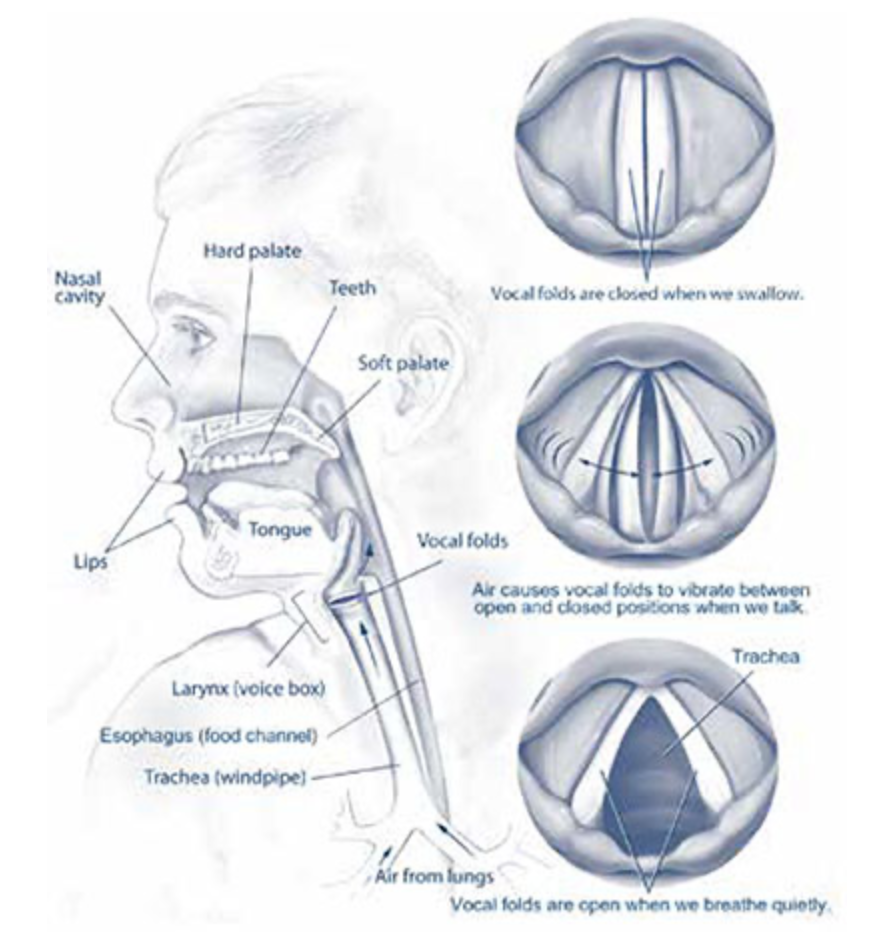
The voice is made when air from the lungs passes between two small bands of tissue in the voice box (larynx), called the vocal folds (sometimes called "vocal cords"). The air makes them vibrate, producing sound. Anything that changes the shape, movement, or surface of the vocal folds—swelling, a growth, nerve problems, or muscle tension—can change the voice.
The larynx, also known as the voice box, performs important roles in the generation of sound and speech, in swallowing, and in breathing. Positioned in the neck, specifically between the base of the tongue and the top of the trachea, the larynx consists of various anatomic structures that work harmoniously. When we speak, air expelled from the lungs passes throughthe larynx with the vocal cords closed. Within the larynx, the vocal folds, situated on either side, vibrate against each other as air flows past them, creating sound waves. The pitch of our voice is determined by the tension and length of these folds. As we modulate our voices, muscles within the larynx adjust the position of the vocal folds, altering the pitch, volume, and quality of our speech.
During breathing, the vocal cords open to allow air to pass to and from the lungs.
Additionally, the larynx acts as a crucial guardian of the lower airway, preventing food from entering the trachea and directing it toward the esophagus.
Common Causes of Voice Problems
Most short-lived hoarseness is caused by a simple problem, but a smaller number of cases have a more serious cause. Common causes include:
Colds and other upper respiratory infections (acute laryngitis). This is the most common cause. It usually clears on its own within about 1 to 2 weeks.
Voice overuse or misuse. Yelling, prolonged loud talking, or heavy vocal demands can strain the voice. This is the most common cause of longer-lasting hoarseness and can lead to muscle tension in the voice box.
Vocal fold growths. Nodules ("singer's nodules"), polyps, and cysts can form from repeated strain, especially in professional voice users.
Acid reflux irritating the voice box.
Smoking, which causes swelling and raises the risk of more serious problems (see warning signs below).
Allergies and post-nasal drip.
Medication side effects, including some inhalers.
Age-related changes in the voice.
Nerve and neurologic conditions affecting the vocal folds (for example, vocal fold paralysis, spasmodic dysphonia, Parkinson disease).
Thyroid problems and, less commonly, other medical conditions.
Cancer of the voice box (larynx). This is uncommon but important, because early detection greatly improves outcomes. Hoarseness is often the first and only sign.
Warning Signs — Seek Prompt Medical Evaluation
Contact your doctor sooner rather than later if hoarseness is accompanied by any of the following:
Hoarseness lasting more than 2 to 3 weeks, especially if you smoke or use tobacco
Coughing up blood
Difficulty or pain with swallowing
Trouble breathing or noisy breathing
Complete loss of voice, or a voice that keeps getting worse
Hoarseness after recent surgery on the neck or chest, or after a breathing tube
Heavy alcohol use combined with tobacco use
If you rely on your voice for your job (for example, a teacher or singer), it is reasonable to be evaluated early rather than waiting, since even mild changes can affect your work.
When to See a Doctor
Brief hoarseness with a cold usually gets better on its own and does not need testing. Guidelines recommend having the voice box examined if hoarseness lasts longer than about 4 weeks, or sooner if any of the warning signs above are present. Do not assume long-lasting hoarseness is "just a cold."
Importantly, imaging scans (CT or MRI) and medications such as reflux pills, steroids, or antibiotics should generally not be used to treat hoarseness before the voice box has actually been looked at, because they can delay finding the real cause.
How It Is Diagnosed
Your doctor will ask about your symptoms, your voice use, your job, smoking and alcohol use, and your medications, and will examine your head and neck. If needed, an ear, nose, and throat specialist (otolaryngologist) can look directly at your vocal folds using a thin scope (laryngoscopy). This is the best way to see what is causing the problem and is the key step before starting most treatments.
Additional Details:

Anatomic sketch with the thyroid removed (dotted line) from the right side view showing anatomy or the right superior laryngeal nerve and the right recurrent laryngeal nerve.
The nerves of the larynx
The nerves of the larynx are the superior laryngeal nerve and the recurrent laryngeal nerve. The superior laryngeal nerve carries sensory fibers to the larynx, while the external branch of this nerve supplies the cricothyroid muscle, responsible for adjusting vocal cord tension during speech, and allowing one to reach a high pitch voice. The recurrent laryngeal nerve controls all of the laryngeal muscles other than the cricothyroid muscle. These muscles move the pieces of the cartilage framework of the larynx for speech, breathing, and swallowing, including the abduction (opening) of the vocal cords for maximal airway and the adduction (closing) of the vocal cords for making noise for speech.
These nerves have a somewhat variable anatomic course from person to person.
Causes of dysphonia (Hoarseness):
The many causes of dysphonia may be categorized into the following groups:
Structural
Neurologic
Functional
Inflammatory
Systemic
These will be elaborated below.
Structural Causes of dysphonia:
Vocal fold lesions (e.g., nodules, polyps, cysts, papillomas, cancer)
Laryngeal trauma or injury
Laryngeal malformations or anatomical abnormalities
Vocal cord lesions

Growths on the vocal cords including nodules, cysts, and tumors can affect the voice because any physical process on the vocal cords can affect the vibrational characteristics of the vocal cord tissue. The size and location of the lesion directly relates to the impact on the voice, with larger lesions or lesions located on the vibrating surface of the vocal cords causing more dysphonia.
Vocal nodules are small, benign growths that develop on the vocal cords, also known as the vocal folds. These nodules are typically caused by excessive or improper use of the voice, such as excessive yelling, singing, or speaking with poor technique.
Vocal cord subepithelial cysts are fluid-filled sacs that develop beneath the surface layer (epithelium) of the vocal cords. These cysts are benign, non-cancerous growths that can form on one or both vocal cords. Subepithelial cysts typically arise from the mucous glands or ducts within the vocal cord tissue. As these structures become blocked or obstructed, fluid accumulates, leading to the formation of a cystic lesion.
Vocal cord papillomas are benign growths that develop on the vocal cords, also known as the vocal folds. These growths are typically small, wart-like lesions that can occur on one or both vocal cords. Vocal cord papillomas are caused by the human papillomavirus (HPV), a common virus that can infect the skin and mucous membranes.
Cancer of the larynx or pre-cancerous lesions such as squamous cell carcinoma in-situ often present first due with dysphonia, especially when the location of the cancer is directly on the vocal cord.
Identification of a growth on the vocal cord visualization of the larynx with use of a scope, usually in a clinic setting. Further testing including videostroboscopy, empiric treatment, or biopsy may be undertaken as needed.
2. Neurological Causes of dysphonia:

The vocal cords move by muscles, and nerves from the brain are the wires that activate these muscles. So, naturally, conditions that affect the nervous system can affect the voice. This can be a vocal tremor, spasmodic dysphonia, vocal cord dysfunction, Parkinson’s disease, and others.
Neurological disorders affecting the larynx (e.g., Parkinson's disease, multiple sclerosis, spasmodic dysphonia)
Neuromuscular disorders, such as myasthenia gravis
3. Functional Causes:
Vocal strain, abuse, or misuse
Muscle tension dysphonia
Vocal Cord Dysfunction / Paradoxical Vocal Cord Movement / Psychogenic dysphonia

Vocal strain
Hoarseness after yelling at a sports event is just one extreme example of vocal strain. More commonly, people who unknowingly develop habits of using their voice that are harsh on the vocal cords, or people who talk a lot, will develop hoarseness. And when people strain to overcome this hoarseness, the problem worsens, creating a downward cycle.

Muscle tension dysphonia
Muscle tension dysphonia (MTD) is a category of hoarseness (dysphonia) characterized by increased muscle tension of the muscles surrounding the voice box and leading to a breathy or harsh voice. This condition arises as multiple factors (including personal temperament, increased vocal use, and underlying medical or physical causes) cause the muscles of the larynx to become tense. This changes the position of the larynx and affects the cartilaginous structures within the larynx leading to abnormal voice production (phonation). Unlike spasmodic dysphonia (described below), MTD affects all vocal tasks (talking, singing). MTD may be the result of a medical condition (such as reflux, a vocal nodule, and post-menopausal hormone levels) or it may be without identifiable physical cause. Diagnosis is made by an otolaryngologist and/or a speech pathologist. Listening to the voice during different vocal tasks, finding elevation of the thyroid cartilage on palpation and seeing a gap between the vocal cords toward the back of the larynx when viewed with a scope are among the examination findings supporting the diagnosis, helping to differentiate MTD from other dysphonias.
Paradoxical vocal cord movement, also known as paradoxical vocal fold motion (PVFM), is a condition characterized by the abnormal closing of the vocal cords during inhalation, rather than the typical opening. This phenomenon can lead to breathing difficulties, stridor, and a sensation of throat tightness or choking. The underlying causes of PVFM are not fully understood, but it is often associated with various medical conditions, such as asthma, gastroesophageal reflux disease (GERD), and psychological factors like anxiety or stress. Proper diagnosis and management of PVFM typically involve a multidisciplinary approach, including speech therapy, respiratory therapy, and, in some cases, pharmacological interventions or even surgical procedures.
4. Inflammatory Causes:
Laryngitis (acute or chronic)
Reflux laryngitis
Allergic or irritant-induced laryngitis
Laryngitis
Laryngitis, both acute and chronic, can significantly impact an individual's voice. Acute laryngitis, most often caused by a viral infection, can result in a hoarse, raspy, or even complete loss of voice due to inflammation affecting the physical vibrational characteristics of the vocal cords.
Chronic laryngitis, on the other hand, is a persistent inflammation of the larynx, which can be caused by various factors such as acid reflux, overuse of the voice, or exposure to irritants. This long-term condition can lead to a permanently altered voice quality, characterized by a breathy, strained, or low-pitched tone, making communication and vocal performance more difficult.

Reflux
Reflux, or more specifically, laryngopharyngeal reflux, is when stomach acid and digestive enzymes travel up the esophagus and contact the lining of the throat and voice box. While the stomach itself has protection against these caustic liquids, the throat does not, and this commonly affects the voice by inciting inflammation, swelling, and even strategies adopted to compensate for the irritation.

Irritants
Like the skin, the vocal cord surface has only so much defense against irritants. Smoke, reflux from the stomach, and other insults can cause swelling, inflammation, and irregularity to to vocal cord surface, which worsens voice quality.
5. Systemic Causes:
Hormonal imbalances (e.g., hypothyroidism, menopause)
Autoimmune disorders (e.g., Sjögren's syndrome)
Aging-related changes in the larynx

Suggestions for preparing for an appointment are on the Make the Most of Your Voice Appointment page.

This page