

Recovery Expectations After Rhinoplasty (Cosmetic and/or Functional)
While not a guarantee for an individual’s experience, this description may inform you on the usual recovery timeline after cosmetic and/or functional rhinoplasty.
Below is a description of recovery after rhinoplasty.
Immediate Postoperative Period (Day 0–3)
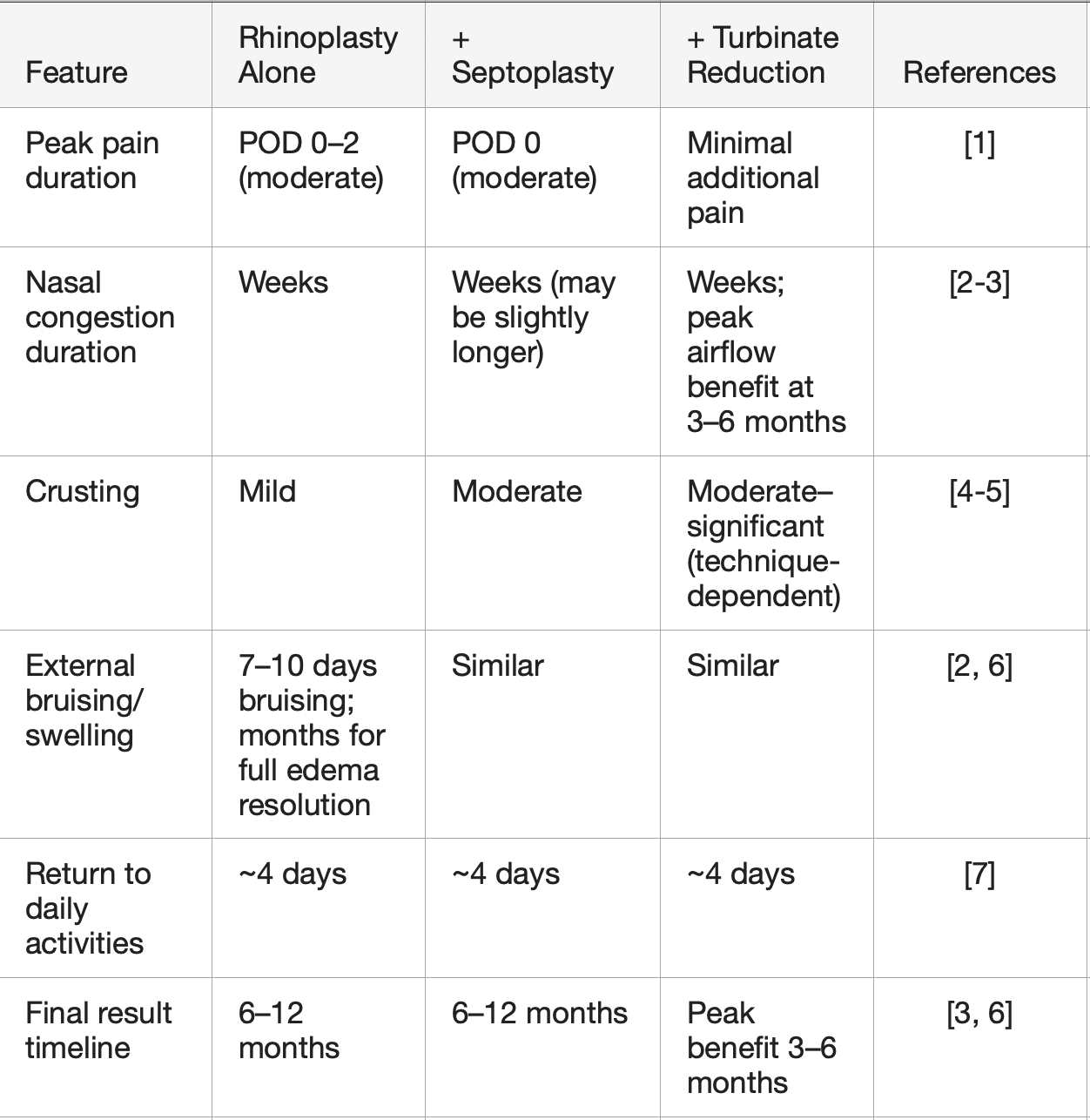
The first 36 to 72 hours represent the most uncomfortable phase. Pain is generally mild to moderate and is seldom severe; after septoplasty alone, average pain reaches moderate levels only on the day of surgery (POD 0), whereas rhinoplasty patients may experience moderate pain through POD 2. [1] Quality-of-life disruption — affecting sleep, general activity, mood, and enjoyment — is greatest during the first 3 postoperative days and closely mirrors pain levels. [2] Patients should expect:
Nasal congestion and obligate mouth-breathing, especially if intranasal splints or packing are placed. Packing, when used, is typically left in place for 24–72 hours and is a significant source of discomfort, causing difficulty swallowing, sneezing, and epiphora (tearing). Many surgeons now use transseptal quilting sutures instead of packing, which significantly reduces early discomfort. [3-5]
Bloody or blood-tinged nasal drainage for the first few days, managed with a drip pad under the nose. [6]
Periorbital bruising and swelling, particularly if osteotomies were performed during rhinoplasty. Bruising typically takes 7–10 days to resolve. [6]
An external nasal cast or splint, which remains in place for approximately 1 week. The cast can feel tight and itchy but is generally not painful. [7]
Nausea from general anesthesia or opioid analgesics, which may be mitigated by perioperative dexamethasone. [6]
Pain management strategies include acetaminophen, NSAIDs (when cleared by the surgeon), ice packs to the cheeks, head elevation to at least 30 degrees, and nasal saline spray to keep the nose clear of crusts. Opioid requirements are low — 90% of patients require 11 or fewer opioid tablets total. [1][6]
First Week (Days 3–7)
By POD 8, quality of life essentially returns to normal baseline levels across all domains (activity, sleep, work, mood, enjoyment, relationships). [2] Key milestones during this week include:
Cast and splint removal, typically around day 5–7. Patients often describe immediate relief and excitement, though the nose appears swollen and the tip may look upturned or "piggy" at this stage.
Resumption of most routine daily activities within approximately 4 days on average. Desk work and light activities can generally resume once the cast is removed, though heavy lifting and dusty/smoky environments should be avoided. [6][8]
Nose-blowing should be avoided for at least 1 week to protect healing structures. [6]
Adding septoplasty to rhinoplasty does not dramatically change the early recovery trajectory in terms of pain, though patients may notice more intranasal congestion and crusting. Postoperative complications of septoplasty occur in approximately 18% of patients, most commonly mild hemorrhage and infection manageable in the outpatient setting. [9]
Adding turbinate reduction may produce additional crusting, mild bleeding, and nasal dryness in the early weeks. [10-11] The technique matters: microdebrider-assisted turbinoplasty produces significantly less crusting (40%) compared to partial or complete turbinectomy (79–89%). [11] Radiofrequency ablation and coblation techniques also tend to have favorable postoperative comfort profiles. [12]
Weeks 2–6
Nasal congestion gradually improves as internal swelling subsides. Patients should expect:
Persistent nasal stuffiness that may take weeks to fully resolve. [6]
The nose remains tender and sensitive to touch for up to 3 months. [6]
External swelling is still noticeable, particularly at the nasal tip. Approximately two-thirds of postoperative swelling (edema) resolves within the first month. [13]
Patients with concurrent turbinate reduction may notice progressive improvement in nasal airflow during this period, with peak benefit typically achieved between 3–6 months. [14]
Months 2–12 and Beyond
The final cosmetic result of rhinoplasty emerges slowly. Three-dimensional morphometric studies demonstrate that 95% of swelling (edema) resolves by 6 months and 97.5% by 1 year, with a plateau at approximately 84% of the initial postoperative volume. [13] Patients with thicker skin may take longer to see definition. The nose may remain tender for up to 3 months. [6] Contact sports are typically restricted for several weeks to months. [6]
Satisfaction and Revision Rates
Overall patient satisfaction with rhinosurgery is high — approximately 80–86% of patients report general satisfaction, and 81% would undergo the procedure again. [15] The revision rate after primary rhinoplasty is approximately 2–10.5%, rising to ~24% after revision rhinoplasty. [6][16-17] Persistent nasal obstruction is the most common reason patients seek additional surgery after septoplasty, sometimes requiring rhinoplasty for nasal valve or structural issues. [18]
Key Differences by Procedure Combination
references
Postoperative Pain and Analgesic Requirements After Septoplasty and Rhinoplasty.
The Laryngoscope. 2019. Sclafani AP, Kim M, Kjaer K, Kacker A, Tabaee A.
2. Prospective Qualitative Multidimensional Assessment of the Postoperative Rhinoplasty Experience.
Facial Plastic Surgery & Aesthetic Medicine. 2020. Gadkaree SK, Shaye DA, McCarty JC, et al.
European Archives of Oto-Rhino-Laryngology : Official Journal of the European Federation of Oto-Rhino-Laryngological Societies : Affiliated With the German Society for Oto-Rhino-Laryngology - Head and Neck Surgery. 2017. Kayahan B, Ozer S, Suslu AE, Ogretmenoglu O, Onerci M.RCT
4. Clinical Consensus Statement: Septoplasty With or Without Inferior Turbinate Reduction.
Otolaryngology--Head and Neck Surgery : Official Journal of American Academy of Otolaryngology-Head and Neck Surgery. 2015. Han JK, Stringer SP, Rosenfeld RM, et al.Guideline
Aesthetic Plastic Surgery. 2026. Barone M, Amenta A, Rossi S, et al.RecentSR
6. Clinical Practice Guideline: Improving Nasal Form and Function After Rhinoplasty.
Otolaryngology--Head and Neck Surgery : Official Journal of American Academy of Otolaryngology-Head and Neck Surgery. 2017. Ishii LE, Tollefson TT, Basura GJ, et al.Guideline
7. The Effects of Vibration and Pressure Treatments in the Early Postoperative Period of Rhinoplasty.
Aesthetic Surgery Journal. 2020. Taş S.RCT
8. Patient Recovery and Satisfaction With Perioperative Care After Rhinoplasty.
Facial Plastic Surgery & Aesthetic Medicine. 2021. Yamasaki A, Warinner C, Lindsay R.
Lancet. 2019. van Egmond MMHT, Rovers MM, Hannink G, Hendriks CTM, van Heerbeek N.RCT
JAMA Otolaryngology-- Head & Neck Surgery. 2023. Park SC, Kim DH, Jun YJ, et al.SR
European Archives of Oto-Rhino-Laryngology : Official Journal of the European Federation of Oto-Rhino-Laryngological Societies : Affiliated With the German Society for Oto-Rhino-Laryngology - Head and Neck Surgery. 2026. M S, M A.Recent
12. Medial Flap Coblation Turbinoplasty Versus Submucous Resection: Outcomes.
American Journal of Rhinology & Allergy. 2023. El-Sisi HE, Etman M, Ebada HA.RCT
13. Postoperative Edema Resolution Following Rhinoplasty: A Three-Dimensional Morphometric Assessment.
Plastic and Reconstructive Surgery. 2016. Pavri S, Zhu VZ, Steinbacher DM.
14. Systematic Review of Surgical Interventions for Inferior Turbinate Hypertrophy.
American Journal of Rhinology & Allergy. 2023. Zhang K, Pipaliya RM, Miglani A, Nguyen SA, Schlosser RJ.SR
15. Treatment Success After Rhinosurgery: An Evaluation of Subjective and Objective Parameters.
European Archives of Oto-Rhino-Laryngology : Official Journal of the European Federation of Oto-Rhino-Laryngological Societies : Affiliated With the German Society for Oto-Rhino-Laryngology - Head and Neck Surgery. 2022. Martin MM, Hauck K, von Witzleben A, et al.RCT
16. Differences Between Primary and Revision Rhinoplasty: Indications, Techniques, Grafts, and Outcomes.
Plastic and Reconstructive Surgery. 2021. Hacker S, Pollock J, Gubisch W, Haack S.
17. Incidence of Postoperative Adverse Events After Rhinoplasty: A Systematic Review.
Plastic and Reconstructive Surgery. 2020. Sharif-Askary B, Carlson AR, Van Noord MG, Marcus JR.SR
18. Back for More: Why Patients Seek Rhinoplasty After Septoplasty.
The Journal of Laryngology and Otology. 2026. Serdoura Alves C, Mesquita B, Lino J, Gonçalves Ferreira M, Santos M.Recent

This page