

Treatments: Serous Otitis Media (Otitis Media with Effusion)

Serous otitis media — also called otitis media with effusion (OME) — is fluid behind the eardrum without signs of acute infection: no fever, no ear pain, no bulging or reddened eardrum.
Because that fluid can dampen sound transmission to the inner ear, treatment decisions in children are driven by how long the effusion has persisted and the child's risk for developmental impairment.
when to treat serous otitis media in children
Treatment is recommended when:
Serous otitis media has persisted for more than three months, or
At the time of diagnosis, in children with risk factors for developmental impairment (see "At-Risk Children," below)
Outside these situations, observation is appropriate, with hearing and language monitored during the watch period.
how to treat serous otitis media in children:
Children younger than four years old: Tympanostomy tube placement
Adenoidectomy is not recommended for serous otitis media in children younger than four year old, but could be undertaken when there is a separate reason for performing adenoidectomy, such as chronic adenoid infection or nasal airway obstruction due to large adenoids.
Children four years of age and older: Tympanostomy tube placement and adenoidectomy
How not to treat serous otitis media in children:
The following lack evidence for treating serous otitis media in children ages 2–12. They may still be appropriate for a separate, concurrent condition:
Intranasal steroids (such as Flonase, Nasocort, Rhinocort)
Systemic (oral) antibiotics
Antihistamines (such as Benadryl, Zyrtec, Claritin, Allegra)
Decongestants (such as Sudafed, Afrin spray)
In contrast, a maximal medical regimen for Eustachian tube dysfunction may be considered for those with serous otitis media older than 12 years of age.
AT-RISK CHILDREN with serous otitis media
Some children carry a higher risk of developmental impairment from middle ear fluid, so treatment shifts from observation to intervention sooner than it would otherwise. At-risk conditions include:
Permanent hearing loss independent of otitis media with effusion
Suspected or confirmed speech and language delay or disorder
Autism spectrum disorder or other pervasive developmental disorders
Syndromes (e.g., Down syndrome) or craniofacial disorders involving cognitive, speech, or language delay
Blindness or uncorrectable visual impairment
Cleft palate, with or without an associated syndrome
Developmental delay
Any sensory, physical, cognitive, or behavioral factor placing a child with otitis media with effusion at increased risk for developmental difficulty
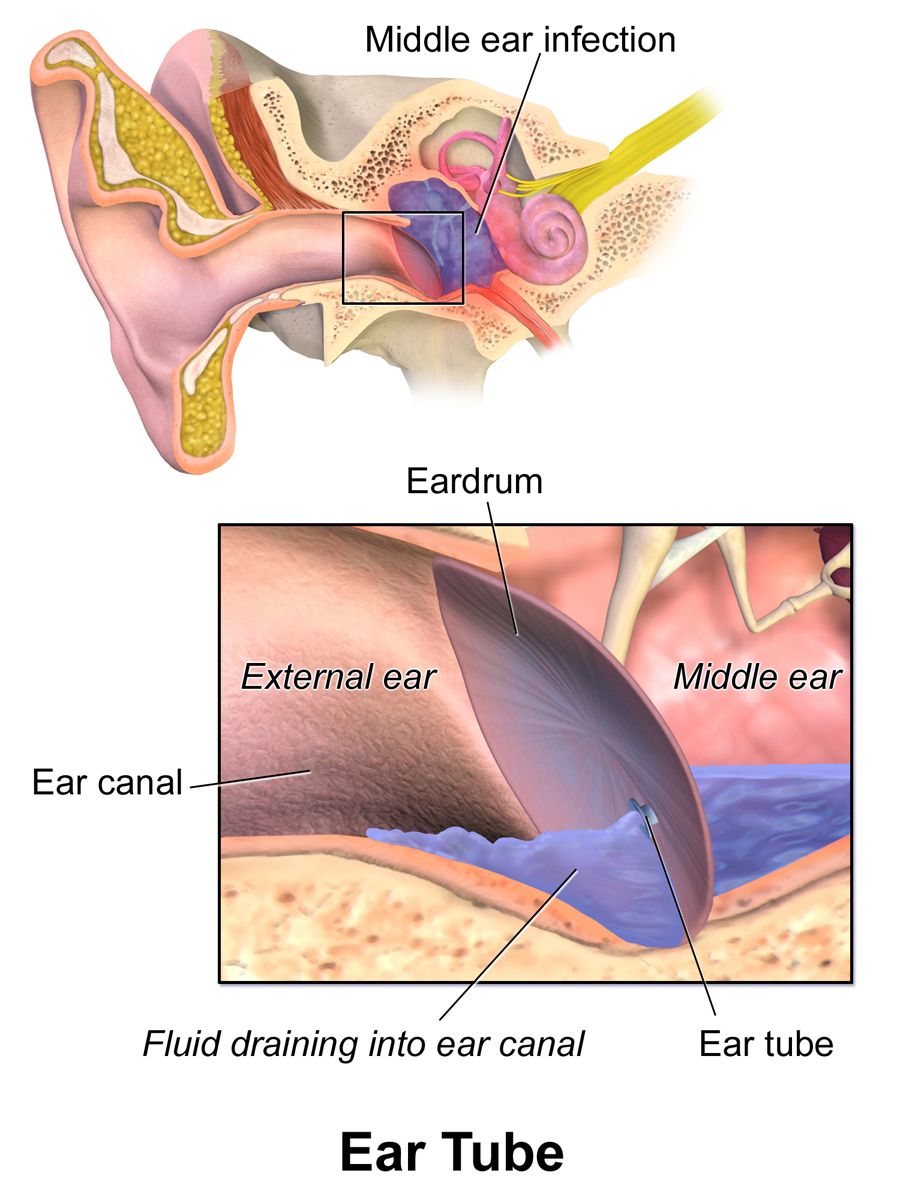
ear tubes (“PE,” tympanostomy tubes, or Pneumatic equalization tubes)
Fluid in the middle ear (shown in brown) dampens transmission of sound waves to the inner ear. A surgeon can create a small opening in the eardrum to let the fluid out. A surgeon may also place a tube (not shown) to keep this opening from closing rapidly.
Ear tube (tympanostomy tube) placement is simple and effective, typically taking only minutes. Tubes work by:
Equalizing air pressure across the eardrum, independent of Eustachian tube function
Allowing fluid or pus to drain from the middle ear space
Allowing antibiotic drops to reach the middle ear space

This page