

Bethesda 4 Nodule
This page describes interpretation and management for a thyroid nodule whose needle biopsy was read as category 4 in The Bethesda System.
Bethesda IV (follicular neoplasm/suspicious for follicular neoplasm) nodules carry a mean estimated risk of malignancy of 30% (range 23%–34%) inclusive of NIFTP, and management hinges on molecular testing results, clinical/radiographic suspicion, and ultrasound (TI-RADS) characteristics. [1-2]
NCCN-Recommended Management Algorithm
The NCCN Thyroid Carcinoma Guidelines (v2.2026) outline a two-step approach for Bethesda IV nodules: [1]
Step 1 — Assess clinical and radiographic suspicion of malignancy:
If there is high clinical and/or radiographic suspicion (based on rapid growth, imaging findings, physical exam, age, radiation history, family history): consider lobectomy or total thyroidectomyfor definitive diagnosis/treatment.
If there is no high suspicion: proceed with molecular analysis, consider diagnostic lobectomy, or work up an autonomous nodule if hyperthyroid.
Step 2 — Management based on molecular analysis results: [1]
Benign/negative: Nodule surveillance per ATA guidelines
Intermediate suspicion: Nodule surveillance or consider lobectomy
Not informative / insufficient sample: Consider repeat biopsy, nodule surveillance, or lobectomy in select situations
Suspicious/positive for malignancy: Consider lobectomy or total thyroidectomy (extent guided by specific molecular findings, e.g., BRAF V600E directs toward papillary carcinoma pathway), or active surveillance for low-risk papillary thyroid cancer
When surgery is pursued for a Bethesda IV nodule, the NCCN recommends: [1]
Total thyroidectomy if there is radiographic evidence or intraoperative findings of extrathyroidal extension (ETE), bilateral nodularity, tumors >4 cm, or patient preference
Lobectomy/isthmusectomy otherwise, with further management dictated by final surgical pathology
Role of ACR TI-RADS in Modifying Management
The ACR TI-RADS score provides an important layer of risk stratification that can influence management decisions for Bethesda IV nodules, though the NCCN guidelines do not explicitly incorporate TI-RADS categories into their treatment algorithm. Key considerations:
TI-RADS 2 (not suspicious): The malignancy risk is very low. For indeterminate cytology nodules with TI-RADS 2 features, follow-up/surveillance is a reasonable option, and molecular testing may be deferred if the nodule is small. [3]
TI-RADS 3 (mildly suspicious): Malignancy risk remains low (~2.9% for nondiagnostic nodules). For Bethesda IV nodules with TI-RADS 3 features, molecular testing is particularly useful to guide the decision between surveillance and surgery. A negative molecular result in this setting strongly supports surveillance. [3-4]
TI-RADS 4 (moderately suspicious): Malignancy risk is intermediate (~5.9% overall, higher with indeterminate cytology). Molecular testing plays a key role here — a positive result more strongly supports surgical intervention, while a negative result may still warrant close surveillance or consideration of lobectomy depending on clinical context. [3-5]
TI-RADS 5 (highly suspicious, ≥7 points): Malignancy risk is substantially elevated (~46% for nondiagnostic nodules). For Bethesda IV nodules with TI-RADS 5 features, surgical excision (lobectomy or total thyroidectomy) is more strongly favored even if molecular testing is negative, as a negative molecular result does not reliably rule out malignancy in this high-suspicion setting. [3-4]
Integrating TI-RADS with Molecular Testing
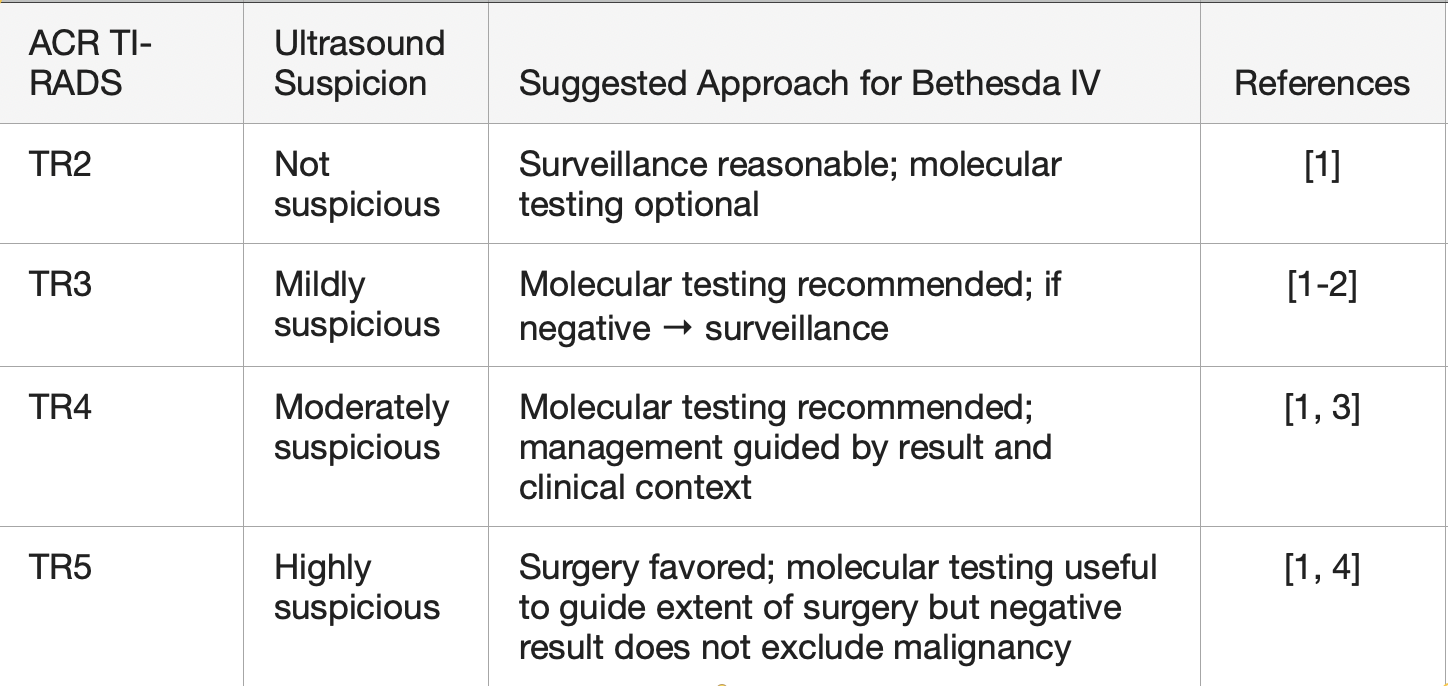
A practical framework supported by the literature: [3][6]
ACR TI-RADSUltrasound SuspicionSuggested Approach for Bethesda IVReferencesTR2Not suspiciousSurveillance reasonable; molecular testing optional[1]TR3Mildly suspiciousMolecular testing recommended; if negative → surveillance[1-2]TR4Moderately suspiciousMolecular testing recommended; management guided by result and clinical context[1, 3]TR5Highly suspiciousSurgery favored; molecular testing useful to guide extent of surgery but negative result does not exclude malignancy[1, 4]
The NCCN guidelines emphasize that molecular analysis results should always be interpreted in the context of clinical, radiographic, and cytologic features of each individual patient. [1] A recent real-world study demonstrated that active surveillance for Bethesda IV nodules with TI-RADS 2–4 and no high-risk features showed high stability (87.6% growth-free at 48 months) and low surgical conversion rates (14.1%), supporting the feasibility of surveillance in appropriately selected patients. [7]
Molecular tests such as ThyroSeq v3 and Afirma GSC have demonstrated high negative predictive values for Bethesda IV nodules (false-negative rate ~0.6% over 34 months of median follow-up), supporting nonoperative management when results are benign/negative. [8-9] However, Bethesda IV nodules with negative molecular results still carry a somewhat higher prevalence of malignancy than Bethesda III (7.3% vs. 1.6%), warranting continued surveillance. [10]
References:
National Comprehensive Cancer Network. Updated 2026-06-02.Guideline
2. Molecular Testing for the Management of Indeterminate Thyroid Nodules.
Endocrine-Related Cancer. 2026. Azaryan I, Maxwell C, Tran DH, Sipos JA, Endo M.Recent
Diagnostic Cytopathology. 2019. Rocha TG, Rosario PW, Silva AL, Nunes MB, Calsolari MR.Opinion
Cancer Cytopathology. 2026. Waters L, Cullen TM, Goldstein MB, et al.Recent
Clinical Endocrinology. 2025. Wang Y, Tang Y, Luo Z, Li J, Li W.
Diagnostic Cytopathology. 2019. Li F, Pan D, Wu Y, et al.SR
7. A Real-World Experience of Active Surveillance in Bethesda IV Thyroid Nodules.
Endocrine. 2026. Santivañez JJ, García-Lozano CA, Betancourt C, et al.RecentObservational
The Journal of Clinical Endocrinology and Metabolism. 2023. Kim NE, Raghunathan RS, Hughes EG, et al.RCT
Annals of Surgery. 2020. Carty SE, Ohori NP, Hilko DA, et al.
Thyroid : Official Journal of the American Thyroid Association. 2025. Nachum S, Tondi Resta I, Baloch Z, Mandel SJ.

This page