
Bethesda 5 Nodule
This page describes interpretation and management for a thyroid nodule whose needle biopsy was read as category 5 in The Bethesda System.
Bethesda V (suspicious for malignancy) nodules should generally be referred for surgical excision, as the estimated risk of malignancy is mean 74% (range 67%–83%) inclusive of NIFTP. [1] Molecular testing is not routinely recommended for Bethesda V given this high pretest probability; instead, surgery is favored, though molecular data may help inform the extent of resection. [2]The ACR TI-RADS score primarily influences the pre-biopsy decision of whether to perform FNA, but once a Bethesda V result is obtained, the TI-RADS category has a more limited — though still relevant — role in refining risk and guiding surgical extent.
Management of Bethesda V Nodules per NCCN Guidelines
The NCCN Thyroid Carcinoma Guidelines (v2.2026) direct management based on cytologic subtype: [1]
Papillary or suspicious for papillary → proceed to primary treatment per the papillary carcinoma algorithm (PAP-1)
Medullary or suspicious for medullary → proceed to medullary carcinoma algorithm (MEDU-1)
Anaplastic or suspicious for anaplastic → proceed to anaplastic carcinoma algorithm (ANAP-1)
Surgical Approach
For nodules <4 cm, both lobectomy and total thyroidectomy are acceptable. [3]
Total thyroidectomy is preferred when: [1][3]
Nodule is >4 cm
There is clinical or radiologic evidence of gross extrathyroidal extension
There is evidence of lymph node or distant metastases
History of radiation exposure or contralateral lobe lesions
Molecular testing (if performed) shows a high risk mutation profile (See below.)
For small (<1 cm) intrathyroidal papillary cancers, active surveillance without surgery may be considered in select patients. [3-4]
Role of ACR TI-RADS in the Context of Bethesda V
It is important to distinguish between two phases where TI-RADS plays a role:
1. Pre-biopsy: TI-RADS determines whether FNA is indicated
ACR TI-RADS uses a points-based system across five ultrasound feature categories to assign risk levels, with size-dependent thresholds for FNA: [5-6]
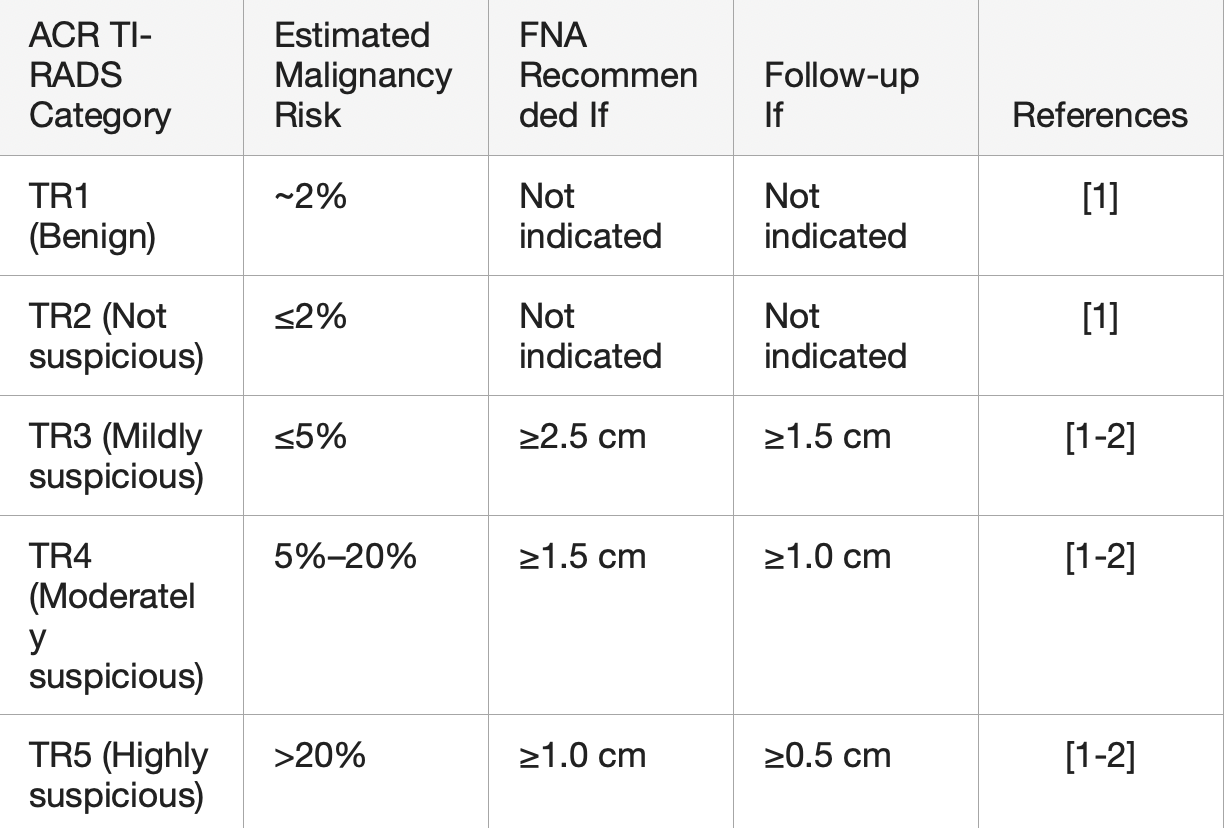
A nodule that is TR3 and <2.5 cm, or TR4 and <1.5 cm, would not meet ACR TI-RADS criteria for FNA — meaning a Bethesda V result would not typically be obtained in these scenarios unless clinical judgment overrode the size threshold.
2. Post-biopsy: TI-RADS as an adjunctive risk modifier
Once Bethesda V cytology is obtained, the TI-RADS score does not fundamentally change the recommendation for surgery, but it can refine risk assessment:
TR5 + Bethesda V: This concordant combination carries the highest risk. In one study, all TI-RADS 5 nodules with Bethesda V/VI cytology that underwent surgery were confirmed malignant on histopathology. Higher TI-RADS point totals within TR5 correlate with higher malignancy rates (mean 9.3 points for malignant vs. 7.3 for benign). This concordance may favor a more definitive surgical approach (total thyroidectomy). [8]
TR4 + Bethesda V: This is a moderately concordant scenario. The malignancy rate for surgically excised TR4 nodules is approximately 10.9% overall, but when cytology is Bethesda V, the risk is substantially higher. Combining TI-RADS with Bethesda diagnosis improves predictive power over Bethesda alone. [9-10]
TR3 + Bethesda V: This represents a discordant scenario — low sonographic suspicion but high cytologic suspicion. Such discordance warrants a multidisciplinary team approach. The overall malignancy rate for TR3 nodules is low (~2%–5%), so a Bethesda V result in this setting may prompt consideration of repeat FNA, second-opinion cytopathology review, or molecular testing before committing to surgery, though surgery remains the standard recommendation. [3][11]
TR1/TR2 + Bethesda V: This is a highly discordant finding. Given the very low sonographic risk, repeat FNA and expert cytopathology review should be strongly considered to exclude sampling error or misclassification before proceeding to surgery.
Key Takeaway
Bethesda V nodules have a high likelihood of being cancerous and merit surgery most of the time. The ultrasound TI-RADS score is most impactful in the pre-biopsy phase (determining whether to perform FNA) and for indeterminate cytology (Bethesda III/IV), where it meaningfully shifts the probability of malignancy and can guide the decision between surveillance, molecular testing, and surgery. [10][12-13] Once Bethesda V cytology is established, surgery remains the standard recommendation regardless of ultrasound TI-RADS category, though discordant TI-RADS/Bethesda results should prompt careful reassessment including possible repeat FNA and multidisciplinary review. [1-3][14]. Molecular testing is not routinely performed for Bethesda V nodules, but when this information is available, it may help guide extent of surgery, as more dangerous mutations may be better served with more extensive surgery.
Molecular Risk Stratification in Bethesda V Nodules
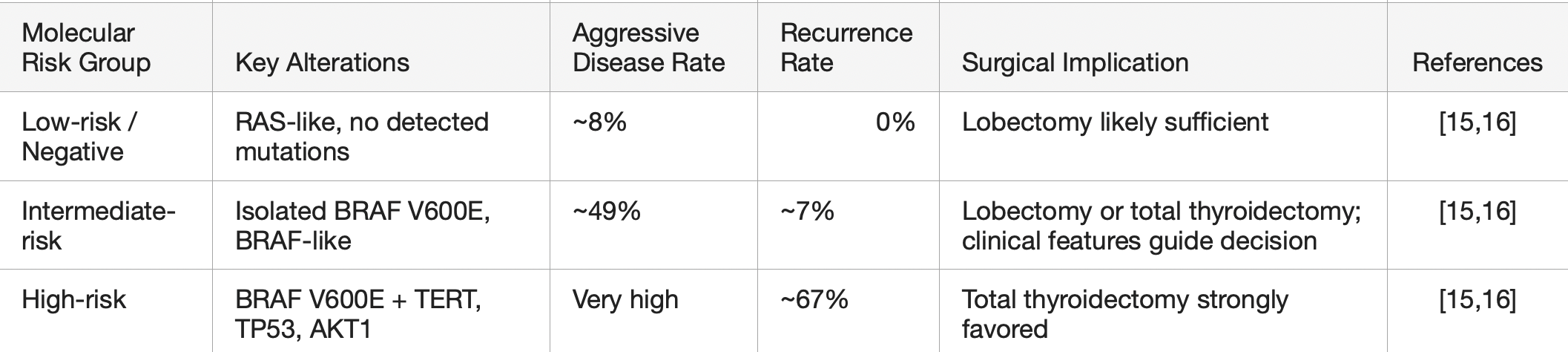
Commercially available platforms (ThyroSeq v3, Afirma GSC/Xpression Atlas, ThyGeNEXT/ThyraMIR) categorize molecular findings into risk tiers that have prognostic implications: [16-17]
Low-risk molecular profile (RAS-like mutations: NRAS, HRAS, KRAS, EIF1AX, PAX8/PPARγ fusions): In a multicenter study of 156 Bethesda V nodules with confirmed malignancy, only 8.2% of patients with low-risk variants had aggressive disease on final pathology. No patients with low-risk or negative molecular results experienced structural recurrence in the Schumm et al. cohort. This profile may support lobectomy as sufficient initial surgery for appropriately selected patients (cT1-T2, N0, no extrathyroidal extension). [18-19]
Intermediate-risk molecular profile (BRAF-like: isolated BRAF V600E, NTRK3 fusions, RET fusions): BRAF V600E was found in 93.3% of intermediate-risk variants in Bethesda V nodules, and these patients had a sixfold higher risk of aggressive disease compared to low-risk variants (49% vs. 8.2%, p < 0.001). In the Schumm et al. study, 7% of patients with intermediate-risk (predominantly isolated BRAF V600E) experienced structural recurrence, with recurrence more common in male patients and those with larger tumors (mean 2.3 vs. 1.5 cm). Isolated BRAF V600E alone, however, does not clearly mandate total thyroidectomy — both lobectomy and total thyroidectomy remain acceptable for 1–4 cm tumors without other high-risk features. [15][18-19]
High-risk molecular profile (BRAF V600E + TERT promoter mutation, TP53, PIK3CA, AKT1): These combinations are uncommon in Bethesda V nodules (~6% of cases) but carry the highest risk. In the Schumm et al. cohort, all 6 patients with high-risk alterations (all BRAF V600E + TERT) underwent total thyroidectomy and RAI, yet 67% experienced recurrence and 50% developed distant metastases. This profile strongly favors total thyroidectomy with consideration for more intensive postoperative surveillance. [18-19]
References:
National Comprehensive Cancer Network. Updated 2026-06-02.Guideline
2. Management of Thyroid Nodules.
The Lancet. Diabetes & Endocrinology. 2022. Alexander EK, Doherty GM, Barletta JA.Review
3.The Diagnosis and Management of Thyroid Nodules: A Review.
The Journal of the American Medical Association. 2018. Durante C, Grani G, Lamartina L, et al.Review
4. Thyroid Nodules: Advances in Evaluation and Management.
American Family Physician. 2020. Kant R, Davis A, Verma V.Review
5. Thyroid Imaging Reporting and Data System (TI-RADS): A User's Guide.
Radiology. 2018. Tessler FN, Middleton WD, Grant EG.Review
6. A prospective comparison of ACR‐TIRADS and EU‐TIRADS in thyroid nodule assessment for FNA‐US.
Clinical Endocrinology. 2023. Eidt LB, Nunes de Oliveira C, Lagos YBB, et al.
7. Temporal Trends in Thyroid Nodule Size on Ultrasonography: A Systematic Review and Meta-Analysis.
JAMA Otolaryngology-- Head & Neck Surgery. 2025. Mann H, Arroyo N, Hsiao V, et al.SR
Surgery. 2023. Wright K, Brandler TC, Fisher JC, et al.
JAMA Network Open. 2023. Huang EYF, Kao NH, Lin SY, et al.Observational
American Journal of Surgery. 2022. Dickey MV, Nguyen A, Wiseman SM.
Cancer Cytopathology. 2025. Yu S, Wang M, Langdon J, et al.Recent
Clinical Endocrinology. 2015. Maia FF, Matos PS, Pavin EJ, Zantut-Wittmann DE.
Diagnostic Cytopathology. 2019. Rocha TG, Rosario PW, Silva AL, Nunes MB, Calsolari MR.Opinion
14. Thyroid Cancer.
Lancet. 2016. Cabanillas ME, McFadden DG, Durante C.Review
Thyroid : Official Journal of the American Thyroid Association. 2025. Ringel MD, Sosa JA, Baloch Z, et al.RecentGuideline
16. Clinical Use of Molecular Data in Thyroid Nodules and Cancer.
The Journal of Clinical Endocrinology and Metabolism. 2023. Alzahrani AS.Review
The Journal of Clinical Endocrinology and Metabolism. 2021. Hu MI, Waguespack SG, Dosiou C, et al.
JAMA Otolaryngology-- Head & Neck Surgery. 2023. Schumm MA, Shu ML, Hughes EG, et al.Observational
19. Guiding Management of Bethesda v Thyroid Nodules: The Role of Molecular Testing.
Clinical Endocrinology. 2025. Tessler I, Morand GB, Gecel NA, et al.Recent
National Comprehensive Cancer Network. Updated 2026-06-02.Guideline
21. Molecular testing in fine‐needle aspiration of thyroid nodules.
Diagnostic Cytopathology. 2023. McMurtry V, Canberk S, Deftereos G.

This page