

Bethesda 6 Nodule
This page describes interpretation and management for a thyroid nodule whose needle biopsy was read as category VI in The Bethesda System.
Bethesda VI (malignant) thyroid nodules should generally be referred for surgical management, with the specific surgical approach (lobectomy vs. total thyroidectomy) determined by tumor size, extent, and clinical features rather than by TI-RADS score. [1-2] The ACR TI-RADS system primarily guides the pre-biopsy decision of whether to perform FNA, but once a Bethesda VI cytologic diagnosis is established, management is driven by the cytologic and clinical findings.
Management of Bethesda VI Nodules
Bethesda VI carries a mean risk of malignancy of 97% (range 97%–100%) inclusive of NIFTP. [1]Per the NCCN guidelines, management depends on the cytologic subtype: [1]
Papillary or suspicious for papillary → Proceed to primary treatment per the papillary carcinoma algorithm (PAP-1), which includes thyroid/neck ultrasound, assessment of vocal cord mobility, and FNA of suspicious lateral neck nodes. Surgery is then determined by preoperative criteria: [1]
Total thyroidectomy is indicated when any of the following are present: distant metastases, extrathyroidal extension (ETE), lateral cervical or gross central lymph node metastases, poorly differentiated/high-grade carcinoma, prior radiation exposure, bilateral nodularity, or tumors >4 cm.
Lobectomy or total thyroidectomy are both acceptable for tumors 1–4 cm without the above high-risk features (lobectomy preferred, category 2B). [1]
Medullary or suspicious for medullary → Proceed per the medullary carcinoma algorithm (MEDU-1).
Anaplastic or suspicious for anaplastic → Proceed per the anaplastic carcinoma algorithm (ANAP-1).
Active Surveillance as an Alternative for Select Bethesda VI Nodules
For low-risk papillary thyroid microcarcinomas (≤1 cm), active surveillance is an acceptable alternative to immediate surgery in properly selected patients. [1][3-4] The NCCN and 2025 ATA guidelines endorse this approach under the following conditions: [1][4]
No aggressive histologic subtypes on FNA
No invasion of the recurrent laryngeal nerve, trachea, or esophagus; no visible ETE
No regional or distant metastases
Tumor not near the posterior capsule or abutting the trachea
Patient willing and able to adhere to surveillance
Access to high-quality neck ultrasound
Surveillance involves neck ultrasound (thyroid and lymph node compartments) every 6 months for 1–2 years, then annually. [1] A systematic review of 5,685 patients on active surveillance showed 100% disease-specific survival, with disease progression in 14.5% and distant metastasis in only 0.03%. [3]
How TI-RADS Scores Interact With Bethesda VI Management
It is important to understand that ACR TI-RADS and the Bethesda system operate at different stages of the diagnostic pathway and serve complementary roles: [5]
ACR TI-RADS is a pre-FNA tool that determines whether a nodule warrants biopsy based on ultrasound features and size thresholds. It assigns points based on composition, echogenicity, shape, margin, and echogenic foci, categorizing nodules from TR1 (benign) to TR5 (highly suspicious, ≥7 points). [6-7]
Bethesda classification is a post-FNA tool that determines management based on cytologic findings.
Once a nodule has been biopsied and classified as Bethesda VI, the TI-RADS score does not change the fundamental recommendation for surgery. However, TI-RADS does influence management in several important ways:
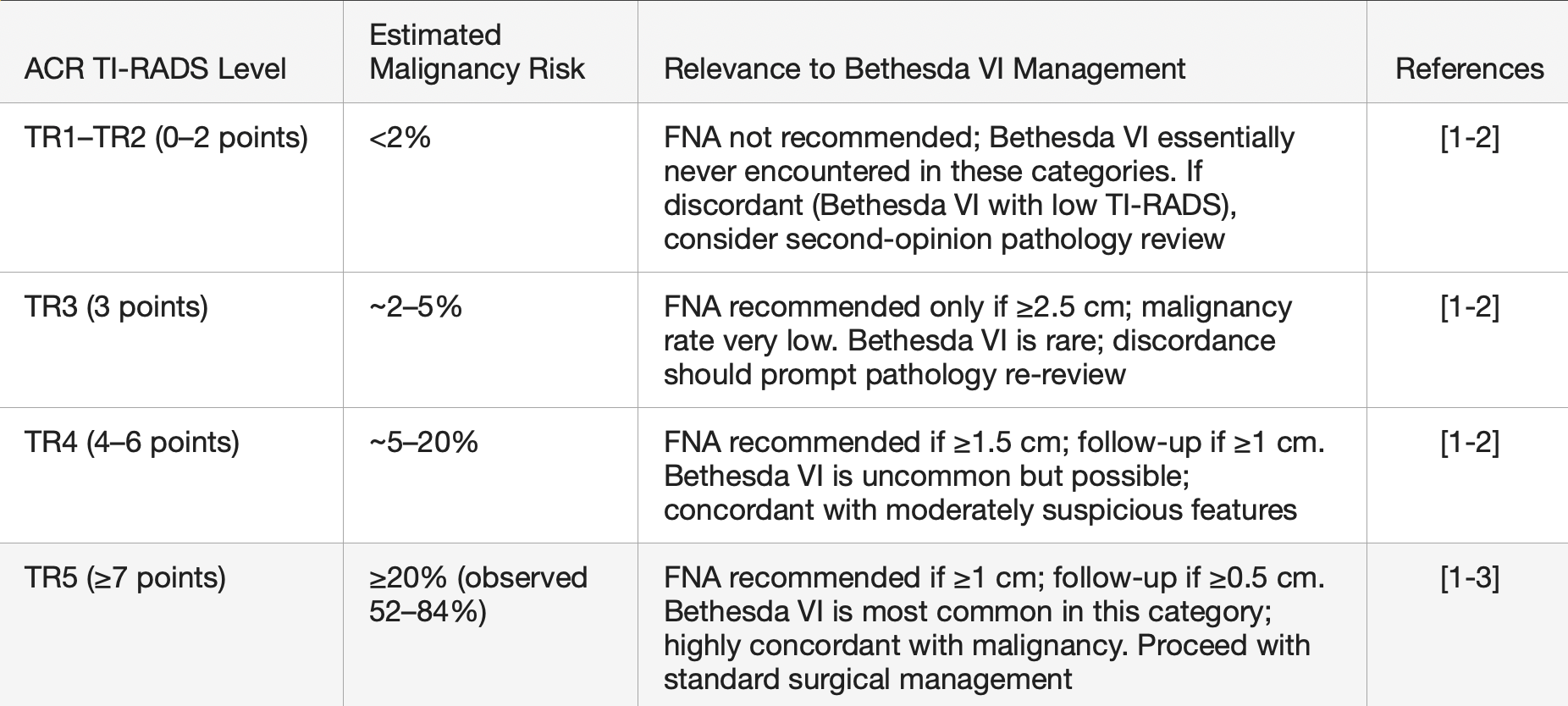
Key clinical scenarios where TI-RADS matters for Bethesda VI nodules:
Concordant high TI-RADS (TR4–5) + Bethesda VI: This is the most common scenario. Proceed with surgical planning as outlined above. The combined use of both systems provides the highest diagnostic accuracy (sensitivity 97.3%, specificity 92.0%). [10]
Discordant low TI-RADS (TR1–3) + Bethesda VI: This is rare but clinically important. No ACR TI-RADS 1, 2, or 3 nodules yielded Bethesda 5 or 6 in one large cohort study. When discordance occurs, a multidisciplinary team approach and second-opinion cytopathology review are recommended. A repeat FNA or second-opinion pathology at a high-volume center should be considered before proceeding to surgery. [1-2][5]
TI-RADS and active surveillance eligibility: For small (≤1 cm) Bethesda VI papillary microcarcinomas being considered for active surveillance, the TI-RADS score provides additional prognostic information. TR5 nodules with high-risk mutations (e.g., BRAF V600E) are associated with higher mortality and may warrant closer surveillance or earlier surgical intervention, though current guidelines do not use TI-RADS as an exclusionary criterion for active surveillance. [1][4][8]
In summary, once Bethesda VI cytology is confirmed, the management pathway is primarily determined by the cytologic subtype, tumor size, and clinical/radiographic features rather than the TI-RADS score. TI-RADS remains most valuable in the pre-biopsy phase and in flagging discordant results that warrant further review.
Influence of molecular testing on management of Bethesda VI nodules:
Routine preoperative molecular testing is not recommended for Bethesda VI nodules according to both the 2025 ATA guidelines and NCCN guidelines, as the extent of surgery is primarily determined by clinical, radiographic, and pathologic features rather than molecular profile. [11] However, when molecular results are known, they can be considered in the context of other clinical data to inform surgical planning.
Guideline Recommendations
The 2025 ATA guidelines (Recommendation 10) state: "Genomic evaluation of confirmed [differentiated thyroid carcinoma] prior to surgery is not recommended routinely. However, if the genomic profile is known or performed, the presence or absence of specific combinations of abnormalities may be considered in the context of clinical, radiographical, and cytopathologic data to inform extent of surgery" (conditional recommendation, low certainty evidence). [11] The rationale is that high-risk mutations are uncommon in cT1b-2N0M0 DTC, and most Bethesda VI nodules are classical PTC harboring BRAF V600E, which alone does not clearly mandate more extensive surgery. [11]
Molecular Risk Stratification Framework
When molecular testing has been performed, results are typically categorized into three risk tiers that carry distinct prognostic implications: [11][13]
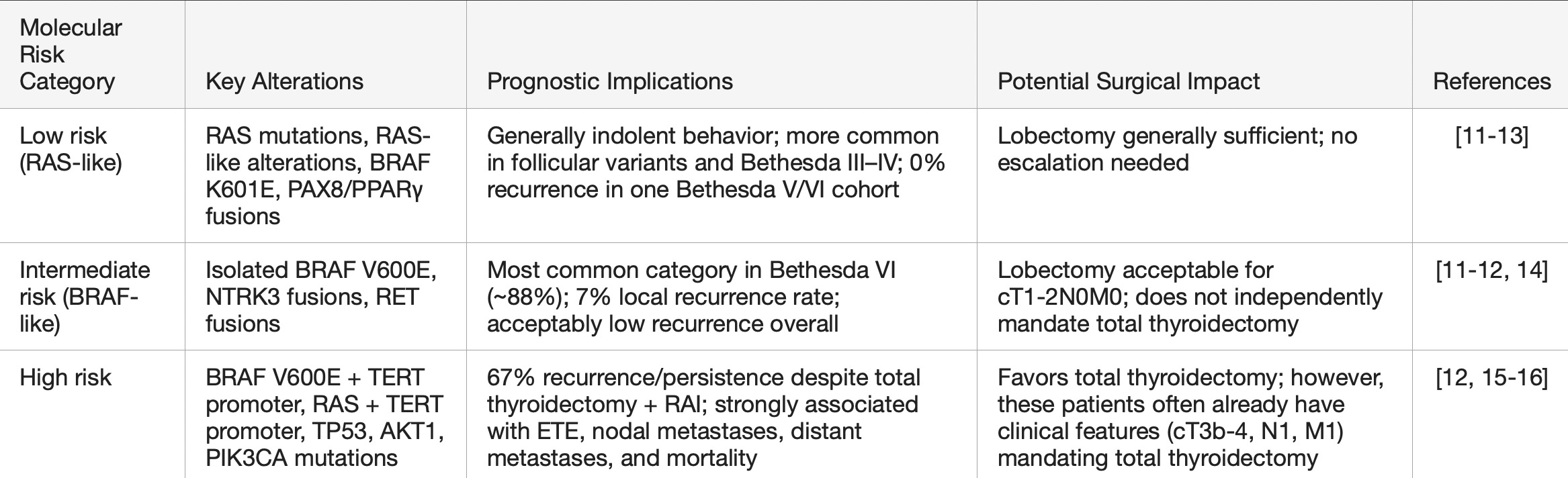
Molecular Risk CategoryKey AlterationsPrognostic ImplicationsPotential Surgical ImpactReferencesLow risk (RAS-like) RAS mutations, RAS-like alterations, BRAF K601E, PAX8/PPARγ fusionsGenerally indolent behavior; more common in follicular variants and Bethesda III–IV; 0% recurrence in one Bethesda V/VI cohort. Lobectomy generally sufficient; no escalation needed[1-3] Intermediate risk (BRAF-like) Isolated BRAF V600E, NTRK3 fusions, RET fusionsMost common category in Bethesda VI (~88%); 7% local recurrence rate; acceptably low recurrence overallLobectomy acceptable for cT1-2N0M0; does not independently mandate total thyroidectomy[1-2, 4]. High riskBRAF V600E + TERT promoter, RAS + TERT promoter, TP53, AKT1, PIK3CA mutations67% recurrence/persistence despite total thyroidectomy + RAI; strongly associated with ETE, nodal metastases, distant metastases, and mortalityFavors total thyroidectomy; however, these patients often already have clinical features (cT3b-4, N1, M1) mandating total thyroidectomy[12, 15-16]
Isolated BRAF V600E Mutation
BRAF V600E is the most common alteration in Bethesda VI nodules (~76% prevalence). [8]Its prognostic significance in isolation is nuanced:
Meta-analyses demonstrate an association with lymph node metastasis (OR 1.38–1.54), extrathyroidal extension (OR 1.62–2.14), and recurrence (OR 1.56–2.14), but no significant association with distant metastases or cancer-related mortality when present in isolation. [9-11]
The 2025 ATA guidelines emphasize that BRAF V600E mutations are common in both small and large DTCs, and their presence in isolation is not clearly associated with more aggressive disease or worse outcomes. Low-risk tumors still harbor BRAF V600E at high frequency. [11]
For TERT promoter-negative, predominantly BRAF V600E-positive tumors (1–4 cm), one study found no difference in disease-free survival between lobectomy and total thyroidectomy (97% vs. 97%, p = NS). [11]
Higher BRAF V600E allele frequency (≥35%) may be associated with gross ETE and increased recurrence risk (HR 7.40), suggesting allele frequency could refine prognostication beyond simple mutation presence/absence. [15]
Co-occurring BRAF V600E + TERT Promoter Mutations
This combination defines the highest-risk molecular subgroup and has the strongest evidence for influencing surgical extent:
A recent study of 756 PTC patients found the BRAF+/TERT+ group had the most aggressive phenotype: 85.2% ETE rate, 63% with ≥5 positive lymph nodes, and the double-mutant status was the strongest independent risk factor for ETE (OR 11.35) and high nodal burden (OR 8.02), with significantly inferior recurrence-free survival. [16]
Co-mutation with TERT promoter reduces disease-specific survival (RR 15.09 compared to wild-type) and is associated with radioiodine resistance (OR 4.8 for loss of RAI avidity). [11][22]
An international multicenter study demonstrated that the BRAF V600E + TERT promoter "genetic duet" effectively upgrades AJCC mortality risk staging by one full stage (I→II, II→III, III→IV), supporting more aggressive treatment including total thyroidectomy over lobectomy, neck dissection, and vigilant surveillance. [13]
However, in Bethesda V/VI cohorts, high-risk mutations are uncommon (~6%), and all patients with high-risk mutations in one study already had T3b-4 and/or N1 and/or M1 disease—features that independently mandate total thyroidectomy regardless of molecular results. [11][13]
RAS Mutations
RAS mutations are rarely encountered in Bethesda VI nodules, as they are primarily found in cytologically indeterminate (Bethesda III–V) nodules and are associated with follicular variants of PTC or FTC. [11] When present:
RAS-like alterations are associated with more indolent behavior, and lobectomy is generally considered sufficient. [14][24]
However, RAS mutations combined with TERT promoter mutations carry a dramatically elevated recurrence risk (adjusted HR 106 in one TCGA analysis), even exceeding the risk of BRAF V600E + TERT promoter co-mutation. [11]
Practical Summary of Molecular Testing Influence on Management of Bethesda VI nodules:
For Bethesda VI nodules, the decision between lobectomy and total thyroidectomy should be driven primarily by tumor size, ETE, nodal status, and distant metastases per NCCN and ATA guidelines. [11-12] Molecular testing is not routinely recommended but may be most useful in the "gray zone" of cT2N0M0 tumors where the surgical extent is uncertain after considering clinical and radiographic features. [11] The identification of high-risk molecular combinations (particularly BRAF V600E + TERT prom2oter) may tip the balance toward total thyroidectomy, though these patients often already have clinical features mandating more extensive surgery.
National Comprehensive Cancer Network. Updated 2026-06-02.Guideline
2. The Diagnosis and Management of Thyroid Nodules: A Review.
The Journal of the American Medical Association. 2018. Durante C, Grani G, Lamartina L, et al.Review
3. Management of Differentiated Thyroid Cancer.
The New England Journal of Medicine. 2026. Hegedüs L, Wirth LJ, Tuttle RM.RecentReview
Thyroid : Official Journal of the American Thyroid Association. 2025. Ringel MD, Sosa JA, Baloch Z, et al.RecentGuideline
JAMA Network Open. 2023. Huang EYF, Kao NH, Lin SY, et al.Observational
Clinical Endocrinology. 2023. Bolland MJ, Grey A.
7. Thyroid Imaging Reporting and Data System (TI-RADS): A User's Guide.
Radiology. 2018. Tessler FN, Middleton WD, Grant EG.Review
Cancer Cytopathology. 2025. Yu S, Wang M, Langdon J, et al.Recent
9. Follow Up or FNAB?: Malignancy Rates of ACR TI-RADS 4 and 5 Thyroid Nodules <10 mm in Diameter.
Otolaryngology--Head and Neck Surgery : Official Journal of American Academy of Otolaryngology-Head and Neck Surgery. 2025. Tobcu E, Karavaş E, Yılmaz GT, Tobcu Z.Recent
Medicine. 2019. Tan H, Li Z, Li N, et al.Observational
Thyroid : Official Journal of the American Thyroid Association. 2025. Ringel MD, Sosa JA, Baloch Z, et al.Guideline
National Comprehensive Cancer Network. Updated 2026-06-02.Guideline
JAMA Otolaryngology-- Head & Neck Surgery. 2023. Schumm MA, Shu ML, Hughes EG, et al.Observational
Clinical Endocrinology. 2023. Valderrabano P, Eszlinger M, Stewardson P, Paschke R.Review
The Journal of Clinical Endocrinology and Metabolism. 2025. Schumm MA, Nikiforov YE, Nikiforova MN, et al.
Cancer Medicine. 2026. Deng C, Cao Y, Deng Y, Chun L, Xinliang S.Recent
Thyroid : Official Journal of the American Thyroid Association. 2025. Calcaterra M, Sada A, Karslioglu-French E, et al.Recent
The Journal of Clinical Endocrinology and Metabolism. 2021. Hu MI, Waguespack SG, Dosiou C, et al.
Endocrine Practice : Official Journal of the American College of Endocrinology and the American Association of Clinical Endocrinologists. 2026. Gatta E, Pirola I, Gandossi E, et al.RecentSR
Cancer. 2012. Kim TH, Park YJ, Lim JA, et al.SR
Oncology. 2026. Fu T, Chen J, Jin X, Gao Y, Du W.RecentSR
Medicine. 2025. Nhung LTT, Hoan NX, Giang DP, et al.Recent
The Lancet. Oncology. 2025. Xing M, Lin S, Mathur A, et al.RecentObservational
24. Management of Thyroid Nodules.
The Lancet. Diabetes & Endocrinology. 2022. Alexander EK, Doherty GM, Barletta JA.Review

This page