
Treatments: Nasal Breathing
This section elaborates on specific treatments for improving breathing problems from the nostrils to the windpipe.

medical approaches to improve the nasal airway
Medical (that is, non-surgical) efforts may adequately improve one’s nasal airway. Several treatment strategies exist, and often overlap and are used together, including the following:
Management of allergies- Identifying allergies, avoiding the triggers, and blunting the allergic response
Use of nasal steroid sprays- Intranasal corticosteroids help reduce inflammation in the nasal passages over time. They are especially effective for chronic conditions such as allergic rhinitis and provide longer-lasting results compared to decongestants.
Use of nasal saline- Saline can wash away mucus, dirt, and allergens from the nose
Avoiding irritants, such as smoke- Irritants such as smoke often cause significant swelling within the nose
Identifying and treating a sinus infection- A sinus infection, which may be longstanding, can cause swelling, accumulation of mucus, and sometimes polyps within the nose
Appropriate use of a systemic nasal decongestant- Taken orally, a systemic decongestant such as pseudoephedrine may help shrink the lining in the nose to make greater space for airflow. Because these medicines circulate through the entire body via the bloodstream, they may affect other organs, such as the heart and the blood vessels themselves. Pseudoephedrine must not be taken by anyone with severe high blood pressure, severe narrowing of the heart (coronary) arteries, narrow angle glaucoma, urinary retention, or within 14 days of taking monoamine oxidase inhibitors, a class of medicines used to treat high blood pressure. Caution is urged for people taking pseudoephedrine with the following conditions: advanced age, children younger than 4 years, heart disease, diseases of the brain blood vessels, an enlarged prostate, glaucoma, hyperthyroidism, Tourette syndrome, and diabetes. Pseudoephedrine may be purchased in limited quantities and without a prescription, but is kept behind the counter and purchase requires providing a valid I.D., signing a log book, and purchases are tracked by a national database.
Appropriate use of topical nasal decongestants- Nasal decongestant medications, available without a prescription as sprays reduce swelling of the nasal lining. They may provide temporary relief by constricting blood vessels in the nasal passages. Decongestant sprays include oxymetazoline (Afrin, Sinex) and phenylephrine (Neosynephrine). These must be used with caution, limiting use of a spray to no more than three days duration, and avoiding oral decongestants with certain medical conditions noted on the label.
Use of a humidifier- Dry air tends to cause crusting and narrowing of the nasal vault
Identification and management of a foreign body in the nose.
Identification and management of a tumor in the sinus or nose.
Some surgical procedures for improving the nasal airway:

septoplasty
Straightening a deviated septum may be performed to improve nasal airflow, unblock a sinus, and in cases where there is a point of contact between the septum and the lining of the nose, septoplasty can resolve a source of facial sinus pain.
turbinate reduction
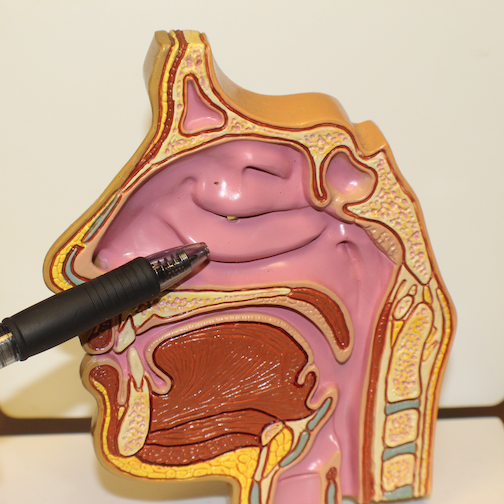
Turbinates are outcroppings of tissue from the left and right walls of the nasal vault. These are normal structures, but occasionally their size can be so large that little space is left for nasal airflow. When medical efforts to shrink the turbinates prove ineffective, surgical reduction of the turbinates may offer improvement in the nasal airway.

management of the nasal valve
The external nasal valve area is the nostrils (external nasal valve) and just a little further back (internal nasal valve) where the sidewall of the nose and the septum are narrow and sometimes get narrower with inspiration. Especially for people with European ancestry, this area accounts for up to 90% of the airflow resistance from the tip of the nose to the lungs!

management of a septal perforation
When the septum (the wall dividing the left from the right side of the nose) has a hole in it (perforation), sometimes crusts build up, the septum swells, and/or nosebleeds occur. All of these impair the nasal airway. Here are some options for treating this vexing problem.

sinus infections
Sinus infections may impair nasal breathing, and sometimes a stuffy nose is the only clue that one has a sinus infection. Click to the right to go to the sinus infection treatment section.

This page