
Procedures: Nasal Septoplasty
What is nasal septoplasty?
Nasal septoplasty is a surgical procedure designed to correct a deviated nasal septum for the purpose of improving nasal function, form, or both. [1] It is one of the most commonly performed ENT operations in adults, with approximately 250,000 performed annually in the United States. [2]
Anatomy and physiology
The nasal septum is a midline structure composed of the septal cartilage (quadrangular cartilage), the vomer bone, and the perpendicular plate of the ethmoid bone. It plays a key role in maintaining nasal shape and modulating airflow. [3] Septal deviation is present in an estimated 70%–80% of the general population, though only a fraction of these individuals are symptomatic. [3-4]
Indications
Nasal obstruction due to septal deviation is the most common indication [3]
Epistaxis, chronic rhinosinusitis, obstructive sleep apnea, and headaches/facial pain from septal spurs (Sluder's syndrome) [3]
As an adjunct procedure to improve surgical access during endoscopic sinus surgery, skull base surgery, or orbital surgery [1][3]
The Nasal Obstruction Symptom Evaluation (NOSE) scale is a validated tool used to assess symptom severity; patients with low scores have a low chance of benefiting from surgery [3]
Preoperative Evaluation
Candidacy is based on patient symptoms and physical examination. The American Academy of Otolaryngology–Head and Neck Surgery (AAO-HNS) consensus statement affirms that anterior rhinoscopy, nasal endoscopy, or both are sufficient to document septal deviation prior to septoplasty. [1] Nasal endoscopy can identify coexisting conditions such as nasal polyps, chronic rhinosinusitis, or tumors, even when anterior rhinoscopy alone confirms the deviation. [1] Photodocumentation and objective tests like rhinomanometry or acoustic rhinometry are not considered necessary. [1]
how does septoplasty improve the nasal airway?
The American Academy of Otolaryngology–Head and Neck Surgery (AAO-HNS) consensus statement affirms that septoplasty improves the nasal airway by correcting structural deviations of the septum, thereby increasing nasal patency and airflow. [1] A systematic review cited in the consensus statement demonstrated that septal surgery improves objective measures of nasal patency and airflow, though instruments such as rhinomanometry and acoustic rhinometry are often not readily available outside research settings. [1]
Beyond direct airflow improvement, septoplasty can also improve the nasal airway indirectly when performed as an adjunct to endoscopic sinus surgery. By straightening the septum, the procedure eliminates obstruction of the middle meatus and ostiomeatal complex, improving sinus drainage pathways and enabling better postoperative topical medication delivery. [1] One study cited in the consensus statement suggests that septoplasty alone may be adequate for treating chronic rhinosinusitis when a septal deviation contributes to the disease process. [1]
Mechanisms of Airway Improvement
Septoplasty improves the nasal airway through several interrelated physiological mechanisms:
1. Increased cross-sectional area and airflow on the deviated side. By removing or repositioning deviated cartilage and bone, septoplasty widens the narrowed nasal passage. Acoustic rhinometry studies demonstrate a statistically significant increase in the minimum cross-sectional area (MCA2) after septoplasty. [2] Long-term rhinoflowmetry confirms increased nasal airflow and hydraulic diameter specifically on the previously deviated side. [3]
2. Improved peak nasal inspiratory flow (PNIF). In the landmark pragmatic RCT by van Egmond et al. (published in The Lancet), septoplasty patients had a mean PNIF of 124.3 L/min at 12 months compared to 95.0 L/min in the non-surgical group—a significant 29.3 L/min improvement. [4] The NAIROS trial similarly showed improved PNIF and a more balanced inhalational nasal partitioning ratio (the proportion of airflow through each nostril) after septoplasty. [5]
3. Restoration of the nasal cycle. In healthy individuals, airflow alternates between the two nasal cavities in a regular pattern (the nasal cycle). Septal deviation disrupts this cycle. After septoplasty, the number of nasal cycle phases on the non-deviated side decreases, resulting in a more even distribution of the nasal cycle across both cavities, approximating the pattern seen in healthy subjects. [3]
4. Reduction of mucosal inflammation. A prospective study found that septoplasty significantly decreased inflammatory biomarkers (HMGB1, RANTES, IL-4, TNF-α) in nasal secretions, particularly on the concave (previously compressed) side of the septum. This suggests that correcting the deviation not only normalizes airflow but also attenuates nonspecific mucosal inflammation that may contribute to the sensation of obstruction. [6]
How is septoplasty Performed?
Most septoplasties are performed via an endonasal approach through a hemitransfixion incision. [1] Endoscopic septoplasty is a minimally invasive variation that allows maximal preservation of the quadrangular cartilage and supporting framework. [5] For complex or severe deviations—particularly caudal or dorsal deformities involving the L-strut—an open (external) rhinoplasty approach or extracorporeal septoplasty may be required, in which the septal cartilage is removed, reshaped, and reimplanted. [1][4]
Outcomes
Septoplasty is associated with subjectively improved nasal breathing and improved disease-specific quality of life. [1][7] Objective measures show increased nasal airflow and a more even distribution of the nasal cycle across both nasal cavities postoperatively. [7] A pragmatic randomized controlled trial demonstrated that septoplasty improved health-related quality of life compared to non-surgical management in adults with a deviated septum and nasal obstruction. [8]
A meta-analysis of 2,577 patients found a pooled mean NOSE score reduction of 48.8 points (from a baseline of 68.1) at 6 months after septoplasty, representing a critical improvement in patient-reported obstruction. [7] A meta-analysis of RCTs confirmed that septoplasty significantly improved NOSE and SNOT-22 scores compared to non-surgical management at 6 and 12 months, with a low complication rate (revision rate 0.31%, bleeding/infection 4.12%). [8] Notably, subjective improvement may not always correlate perfectly with objective measurements—patient-reported quality-of-life measures often show larger and more consistent effects than rhinomanometry.
what are the risks of septoplasty surgery?
Septoplasty is generally considered a safe procedure with a low overall complication rate of approximately 3.4% in large series, though rates up to 18% have been reported in RCTs when including mild complications. [1-2] The most common risks are hemorrhage and infection, which are typically mild and self-limited. [1][3]
Common Complications
Hemorrhage/septal hematoma — The most prevalent complication, with true hemorrhage reported in 6%–13.4% of cases. In the pragmatic RCT by van Egmond et al. (The Lancet), hemorrhage and infection were the most frequent complications but were mild, requiring only outpatient management with nasal packing or antibiotics. Bleeding requiring hospital readmission occurs in approximately 4% of cases. [1][4]
Infection — Reported in up to 12% of patients in some series, typically managed with local or oral antibiotics. Rarely, infection can progress to septal abscess, which may require hospitalization for intravenous antibiotics. [1][4]
Adhesions (synechiae) — Formation of scar tissue between the septum and lateral nasal wall, more common when concurrent turbinoplasty is performed. [2]
Less Common but Important Complications
Septal perforation — Reported in approximately 0.9%–4.2% of cases. The primary risk factor is bilateral apposing mucosal tears during surgery; when these are recognized and repaired intraoperatively (e.g., with interposition grafts), the risk of perforation is significantly reduced. [5-7]
Structural deformity — Includes nasal tip ptosis, dorsal angulation, and saddle nose deformity, which can result from excessive cartilage removal or inadequate preservation of the L-strut. [4][8]
Anosmia/hyposmia — Altered sense of smell, reported in approximately 11% in one large-scale trial; more common with combined septoplasty and turbinoplasty. [2][4]
Dental/palatal anesthesia — Numbness of the upper incisors due to injury to the nasopalatine nerve. [8]
Rare but Serious Complications
Cerebrospinal fluid (CSF) leak — Results from a tear in the dura mater at the skull base, creating a connection between the nasal cavity and subarachnoid space. [4]
Toxic shock syndrome — A rare but potentially life-threatening complication, historically associated with nasal packing. [4][8]
Endocranial complications — Including pneumocephalus, meningitis, or septicemia from ascending infection. [4]
Ocular complications — Including extraocular muscle damage or temporary reduced visual acuity, particularly with concurrent turbinate surgery. [2][8]
Revision Rate
The need for revision septoplasty due to persistent complaints is low, reported at 0.31% in a meta-analysis of RCTs. [3] In the van Egmond et al. trial, only 1 of 127 surgical patients required revision surgery. [1]
What are the alternatives to septoplasty surgery?
The alternatives to nasal septoplasty fall into two main categories: medical (non-surgical) management and alternative surgical procedures that address different anatomic contributors to nasal obstruction.
Medical Management
Medical therapy is the first-line alternative and typically includes:
Intranasal corticosteroids — Widely used as initial treatment, though a double-blind RCT found no significant effect of intranasal steroids on nasal obstruction scores compared to placebo in patients with obstruction due to a fixed septal deviation (mean NOSE score change: −5.8 for steroid vs. −3.9 for saline, p = 0.60). This suggests that in patients with a purely structural cause of obstruction, medical therapy with steroids is unlikely to be beneficial. [1]
Nasal saline irrigation — Recommended as adjunctive therapy; it assists in mucus clearance and may provide modest symptomatic relief, though it does not address the underlying structural deviation. [2]
Topical decongestants (e.g., oxymetazoline, xylometazoline) — Provide temporary relief by reducing mucosal swelling but are limited to short-term use due to the risk of rhinitis medicamentosa. [3]
In the two major RCTs comparing septoplasty to medical management (the Dutch trial and the NAIROS trial), septoplasty was significantly more effective than medical management. The NAIROS trial showed a 20-point SNOT-22 advantage for septoplasty over nasal steroid plus saline spray at 6 months. [4] In the Dutch trial, approximately three-quarters of patients in the non-surgical arm had already tried intranasal corticosteroids before enrollment, and many continued to have persistent complaints. [3]
Nasal Dilator Devices
External and internal nasal dilators offer a non-invasive, temporary alternative:
External nasal strips (e.g., Breathe Right) dilate the nasal valve and reduce nasal resistance, with MRI studies confirming significant anatomical enlargement of the nasal passage. Their effect is additive with decongestants, as the strip acts primarily anteriorly while decongestants act posteriorly. [5]
Internal nasal dilators (e.g., Airmax, Max-Air Nose Cones) appear to provide greater improvement in PNIF than external strips—one study showed a 110% improvement over baseline with internal cones versus 55% with external strips. A scoping review concluded that both types relieve nasal obstruction, but internal devices demonstrated greater subjective and objective relief. [6-7]
Limitations — These devices are best suited as interim measures while awaiting surgery or for patients who decline or are not candidates for surgery. Approximately 67% of patients were willing to continue using dilators after a 1-month trial, with discontinuation due to local irritation, poor fit, or preference for a permanent surgical solution. [8]
Alternative Surgical Procedures
When nasal obstruction is not solely due to septal deviation, or when specific anatomic sites contribute, alternative or adjunctive surgical options include:
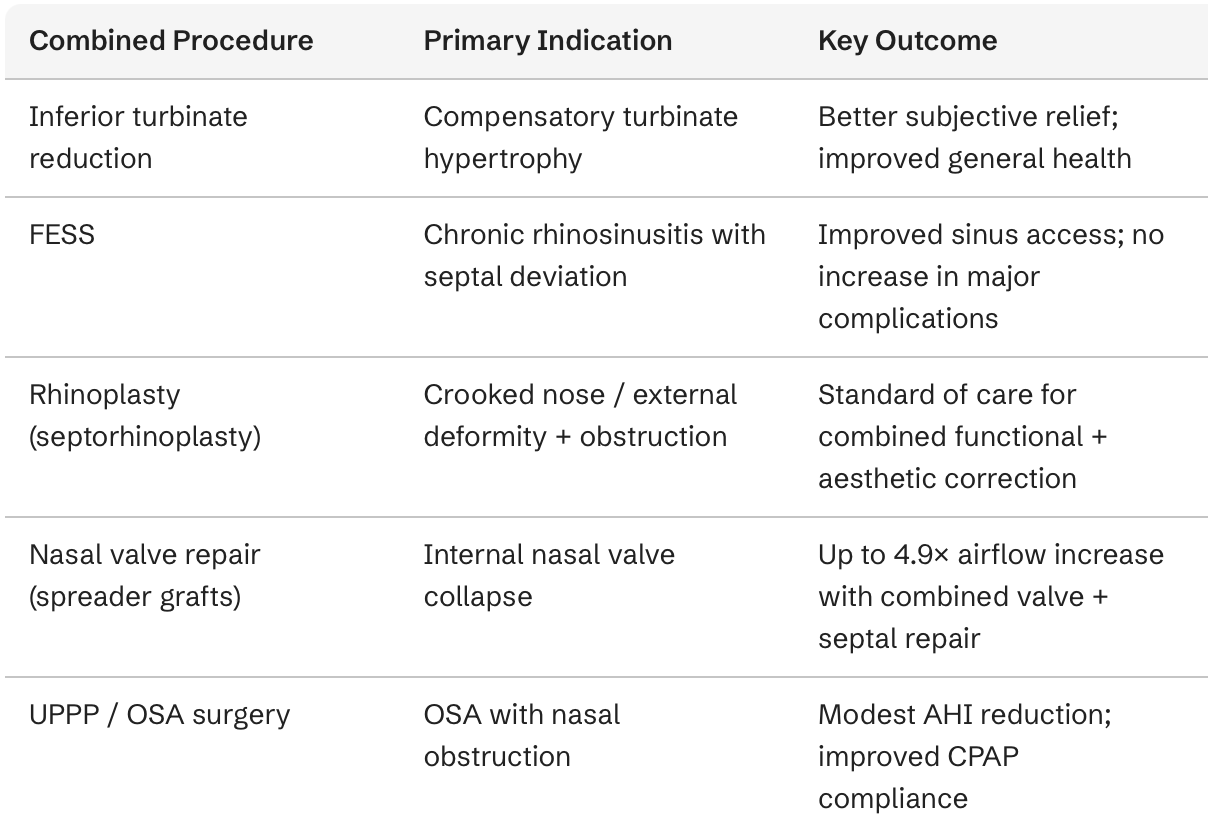
Inferior turbinate reduction — Addresses turbinate hypertrophy, which frequently coexists with septal deviation. Radiofrequency ablation (RFA) is a minimally invasive, office-based option that significantly improves nasal obstruction VAS scores, with benefits sustained 1–5 years postoperatively. A systematic review found that all turbinate reduction techniques (RFA, microdebrider-assisted turbinoplasty, laser, electrocautery) significantly improve nasal obstruction compared to placebo, with peak benefit at 3–6 months. [9-12]
Nasal valve repair — Internal nasal valve collapse is a major and often underdiagnosed cause of obstruction. Spreader grafts, butterfly grafts, alar batten grafts, and bioabsorbable implants (e.g., Latera) can address valve incompetence. One landmark study found that in 54% of patients with lateralized obstruction, the subjectively obstructed side was actually contralateral to the septal deviation—suggesting nasal valve dysfunction rather than septal deviation was the primary cause. [13-16]
Septorhinoplasty — For complex deviations (Type C or Type S), particularly those involving external nasal deformity, combined septorhinoplasty or comprehensive functional surgery achieves the greatest functional and aesthetic improvement compared to septoplasty alone. [17]
Summary comparison of septoplasty and another combined procedure:
References:
American Journal of Otolaryngology. 2025. Africa RE, Hardison SA, Maldonado-Chapa F, McKinnon BJ.Recent
2. Outcomes of Concurrent Functional Endoscopic Sinus Surgery and Rhinoplasty: A Meta-Analysis.
American Journal of Rhinology & Allergy. 2021. Bitner BF, Prasad KR, Goshtasbi K, Dunn BS, Kuan EC.SR
3. Contemporary Considerations in Concurrent Endoscopic Sinus Surgery and Rhinoplasty.
Current Opinion in Otolaryngology & Head and Neck Surgery. 2018. Steele TO, Gill A, Tollefson TT.Review
Lancet. 2019. van Egmond MMHT, Rovers MM, Hannink G, Hendriks CTM, van Heerbeek N.RCT
5. Clinical Consensus Statement: Septoplasty With or Without Inferior Turbinate Reduction.
Otolaryngology--Head and Neck Surgery : Official Journal of American Academy of Otolaryngology-Head and Neck Surgery. 2015. Han JK, Stringer SP, Rosenfeld RM, et al.Guideline
Rhinology. 2022. Bin Lajdam G, Alaryani K, Ghaddaf AA, et al.SR
7. Surgery to Relieve Nasal Obstruction: Outcome for 366 Patients Operated on by One Senior Surgeon.
European Archives of Oto-Rhino-Laryngology : Official Journal of the European Federation of Oto-Rhino-Laryngological Societies : Affiliated With the German Society for Oto-Rhino-Laryngology - Head and Neck Surgery. 2021. Pedersen LA, Dölvik S, Holmberg K, et al.
8. Quality of Life Improvement in Concurrent Septorhinoplasty and Endoscopic Sinus Surgery.
The Laryngoscope. 2024. Bulut OC, Lippert BM, Riedel F, Plath M, Hohenberger R.
9. Surgical Treatment of the Crooked Nose.
Clinics in Plastic Surgery. 2010. Stepnick D, Guyuron B.Review
Journal of Plastic, Reconstructive & Aesthetic Surgery : JPRAS. 2025. Kwon SH, Lee TJ, Hsiao YC, et al.
Plastic and Reconstructive Surgery. 1996. Constantian MB, Clardy RB.Case
12. Evaluating the Effect of Spreader Grafting on Nasal Obstruction Using the NOSE Scale.
The Annals of Otology, Rhinology, and Laryngology. 2017. Standlee AG, Hohman MH.
The Laryngoscope. 2021. Weitzman RE, Gadkaree SK, Justicz NS, Lindsay RW.
Medicine. 2017. Wu J, Zhao G, Li Y, et al.SR
15. Clinical Practice Guideline: Improving Nasal Form and Function After Rhinoplasty.
Otolaryngology--Head and Neck Surgery : Official Journal of American Academy of Otolaryngology-Head and Neck Surgery. 2017. Ishii LE, Tollefson TT, Basura GJ, et al.Guideline
European Archives of Oto-Rhino-Laryngology : Official Journal of the European Federation of Oto-Rhino-Laryngological Societies : Affiliated With the German Society for Oto-Rhino-Laryngology - Head and Neck Surgery. 2026. Aliyeva A, Huseynzada S, Hashimli R, Yılmaz B.Recent

This page