

Diagnostics: Pulmonary Function Test
What is a Pulmonary function test?
Pulmonary function tests (PFTs) are a group of safe, non-invasive breathing tests that measure how well your lungs and airways are working. They do not use needles or surgery. Instead, you breathe into a mouthpiece connected to a machine while a technician coaches you through specific breathing maneuvers. In a head and neck surgery practice, these tests are especially useful for understanding whether a breathing problem is coming from the throat and windpipe (upper airway) or from deeper in the lungs.
What information can be gained from pulmonary function testing?
PFTs look at three main things: how much air your lungs can hold, how quickly you can move air in and out, and how well oxygen passes from your lungs into your blood. Different tests capture different parts of this picture.
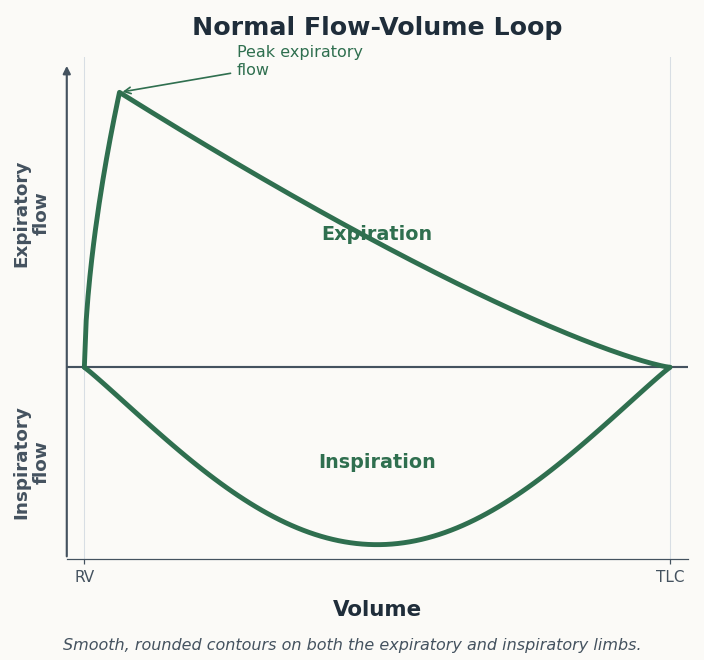
Spirometry. This is the most common breathing test. You take the deepest breath you can and then blow out as hard and fast and long as possible. Spirometry measures how much air you can move (your forced vital capacity) and how much you can blow out in the first second (your FEV1). It also records a "flow-volume loop," a graph of your breathing in and out. The shape of this loop is one of the most useful clues for detecting a narrowing in the throat or windpipe.
Lung volumes. These tests measure the total amount of air your lungs can hold and how much air stays behind after you breathe all the way out. One common method, called body plethysmography, has you sit inside a clear, sealed booth (a bit like a phone booth) and breathe through a mouthpiece while the machine measures pressure changes. Lung volumes help tell whether the lungs are stiff or small versus over-inflated.
Diffusing capacity (DLCO). This test measures how well oxygen moves from the air sacs in your lungs into your bloodstream. You breathe in a tiny, harmless amount of a marker gas (a trace of carbon monoxide), hold your breath briefly, and then breathe out so the machine can measure how much gas was absorbed.
Why These Tests Are Ordered
PFTs are ordered to find the cause of symptoms such as shortness of breath, wheezing, noisy breathing (stridor), chronic cough, or a change in your voice, and to track a known condition over time. In a head and neck practice, they are particularly helpful for problems of the upper airway, including:
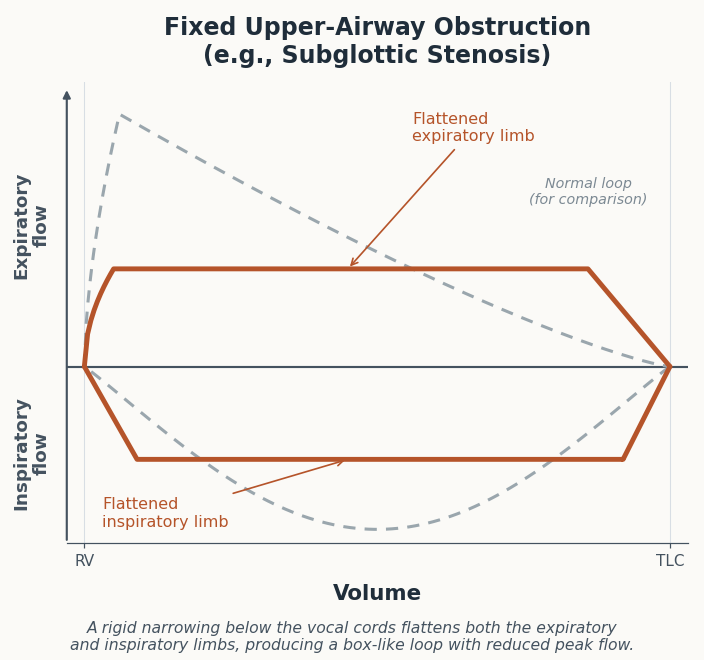
Subglottic stenosis — a narrowing of the windpipe just below the vocal cords. This condition is often mistaken for asthma or COPD, which can delay diagnosis. Certain measurements from spirometry (comparing how fast you can blow out versus your peak flow) can raise suspicion for a narrowing above or in the windpipe.
Vocal cord dysfunction — when the vocal cords close at the wrong time during breathing, causing sudden shortness of breath or throat tightness. The pattern of airflow when breathing in can point toward a problem at the voice box level.
Tracheal narrowing — a narrowing of the windpipe from scar tissue, prior breathing tubes, or other causes. The flow-volume loop can show a characteristic flattened or "plateau" shape.
Importantly, PFTs describe how your airways are functioning, but they cannot by themselves confirm exactly what or where a blockage is. When an upper airway problem is suspected, your surgeon will usually recommend looking directly at the airway with a small camera (laryngoscopy or bronchoscopy) and/or imaging. Normal PFTs do not fully rule out an airway narrowing, so direct examination is often still needed.
How to Prepare
Your care team will give you specific instructions when you schedule, but general preparation includes:
Wear loose, comfortable clothing that does not restrict your chest or belly.
Avoid a large meal and large amounts of liquid right before the test.
Ask about your inhalers and breathing medications. Some tests ask you to hold certain inhalers beforehand, while others do not. Do not stop any medication without checking with the ordering office first.
Avoid vigorous exercise, smoking, and alcohol for a period before the test, as instructed.
Bring a list of your medications, and let the technician know when you last used any inhaler or breathing treatment.
Well-fitting dentures are usually left in place; loose dentures may be removed.
What to Expect During the Test
The test is done sitting down and usually takes 30 to 60 minutes depending on how many parts are ordered. A soft clip is placed on your nose so that all your breathing goes through your mouth, and you seal your lips tightly around a mouthpiece. The technician will coach you loudly and enthusiastically, asking you to breathe in and out in specific ways and to blow out as hard and long as you can. Because the results depend heavily on your effort, you will usually repeat each maneuver several times to get consistent readings. For the lung volume portion you may sit in a clear sealed booth, and for the diffusing capacity portion you will inhale a trace amount of harmless gas and hold your breath briefly. You may be asked to rest between efforts. Blowing out hard can feel tiring or make you cough or lightheaded for a moment.
How Results Are Interpreted
Your results are compared to "predicted" values for someone of your age, height, and sex, and the report describes the pattern of your breathing rather than naming a single disease. The main patterns are:
Obstructive pattern — air comes out more slowly than expected, seen with conditions like asthma and COPD. The key clue is a reduced ratio of how much you blow out in one second compared to your total breath.
Restrictive pattern — the lungs hold less air than expected, which can happen with stiff or small lungs, and is confirmed with lung volume testing.
Upper or central airway obstruction — a narrowing in the throat or windpipe. This shows up as characteristic flattening in the flow-volume loop, sometimes only when breathing in, sometimes only when breathing out, and sometimes both.
Sometimes a "bronchodilator" (a quick-relief inhaler) is given and the test is repeated to see if your breathing improves, which helps distinguish asthma from other conditions. Your surgeon will interpret the results together with your symptoms, examination, and any camera or imaging findings.
Risks and Limitations
PFTs are very safe, and serious problems are rare. Because you breathe forcefully, you may briefly feel lightheaded, cough, or feel short of breath, and fainting can occur occasionally. The forceful maneuvers temporarily raise pressure in the chest, belly, and head, so the test may be delayed or modified in certain situations—for example, recent heart problems, recent eye, chest, abdominal, or head surgery, or an unstable aneurysm. Always tell your care team about recent surgeries or major health events so testing can be timed safely.
Key limitations to keep in mind:
Effort matters. Results are only as good as the effort and coordination you can give, so poor-quality efforts may need to be repeated.
PFTs describe function, not a specific diagnosis. They cannot pinpoint exactly what is causing a narrowing.
Normal results do not rule out an airway narrowing. Early or mild narrowing of the throat or windpipe can be missed, which is why direct examination of the airway is often recommended when an upper airway problem is suspected.
Examples of a normal flow volume loop and an abnormal one showing subglottic stenosis:

This page