

Conditions: Squamous Cell Carcinoma from Mucosa in the Head and Neck
Mucosa is the lining of surfaces like the oral cavity, throat, internal nose and sinuses. Mucosal squamous cell carcinoma is different in many ways from cutaneous squamous cell carcinoma, which arises from skin.
This page describes what mucosal squamous cell carcinoma of the head and neck is, where it starts, what raises the risk of developing it, how it tends to behave, and what influences outlook. It covers the condition itself; treatment is discussed separately.
What This Cancer Is
Squamous cells are flat, tile-like cells that form the surface lining of many parts of the body. In the head and neck, they line the moist inner surfaces (the mucosa, or mucous membranes) of the mouth, throat, voice box, nose, and sinuses. A squamous cell carcinoma is a cancer that begins in these cells.
“Mucosal” squamous cell carcinoma means the cancer starts in this moist inner lining of the upper aerodigestive tract, the shared passageway used for breathing, speaking, and swallowing. About 9 in 10 cancers arising in this region are squamous cell carcinomas.
How It Differs From Skin (Cutaneous) Squamous Cell Carcinoma
Skin squamous cell carcinoma also begins in squamous cells, but it arises in the outer layer of the skin, and its main cause is long-term sun (ultraviolet) exposure. Mucosal squamous cell carcinoma instead arises on the wet lining inside the mouth, throat, voice box, and nose, and its main causes are tobacco, alcohol, and certain viral infections rather than sunlight. Because these are different tissues with different causes and behaviors, the two conditions are considered distinct diseases, even though they share a cell type and a name.

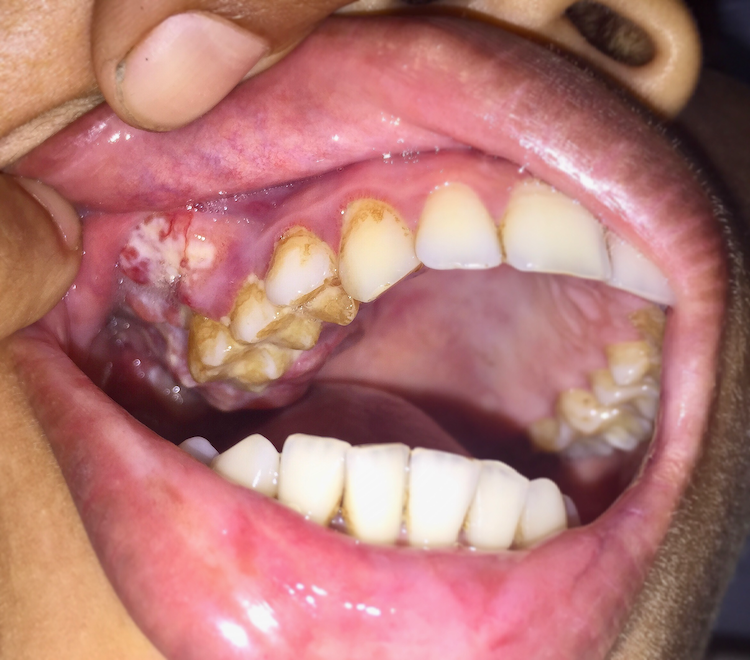
Where It Starts: The Anatomic Sites
The upper aerodigestive tract includes several neighboring regions, and a cancer is named for the region where it begins:
Oral cavity (mouth): the lips, front two-thirds of the tongue, gums, inner cheeks, floor of the mouth, and hard palate.
Oropharynx (middle throat): the area just behind the mouth, including the tonsils, the base (back third) of the tongue, the soft palate, and the back wall of the throat.
Hypopharynx (lower throat): the lowest part of the throat, near the entrance to the esophagus and voice box.
Larynx (voice box): the structure that contains the vocal cords and protects the airway during swallowing.
Nasopharynx (upper throat): the space behind the nose, at the very top of the throat.
Nasal cavity and paranasal sinuses: the inside of the nose and the connected air-filled spaces in the bones of the face.
How the Condition Differs by Site
Although these cancers share a cell type, they behave differently depending on where they start. The site affects what symptoms appear first, how likely the cancer is to spread to lymph nodes, and what causes are most often involved.
Two sites are especially distinct. Cancers of the oropharynx are frequently linked to human papillomavirus (HPV) infection and, when HPV-related, tend to occur in younger people and generally carry a more favorable outlook. Cancers of the nasopharynx are biologically different from the others: they are strongly associated with the Epstein-Barr virus (EBV) rather than with tobacco or alcohol, and they are considered a separate entity with their own causes and behavior. Cancers of the oral cavity and larynx remain most closely tied to tobacco and alcohol.
Risk Factors and Causes
Several factors increase the risk of these cancers. Many, though not all, are related to lifestyle or infection.
Tobacco: Smoking (cigarettes, cigars, pipes) is a major cause, particularly for cancers of the oral cavity and larynx. Smokeless (chewing) tobacco also raises risk. Risk rises with heavier and longer use.
Alcohol: Heavy alcohol use is an independent cause. Tobacco and alcohol together are far more dangerous than either alone; the combination multiplies risk rather than simply adding to it.
Human papillomavirus (HPV): Certain high-risk types of HPV, most often type 16, cause a large share of oropharyngeal cancers, especially in the United States and Europe. This form is spread through intimate contact and is a different disease from tobacco- and alcohol-related cancer, tending to affect younger people with fewer of the traditional risk habits.
Epstein-Barr virus (EBV): This virus is specifically linked to nasopharyngeal cancer.
Betel quid and areca nut: Chewing these products, common in parts of South and Southeast Asia, is a strong cause of oral cavity cancer.
Other factors: Older age, poor oral hygiene, diets low in fruits and vegetables, occupational exposures (such as certain wood dusts and chemicals for sinonasal cancers), air pollution, and rare inherited conditions can also contribute. Cancers in young people without the usual risk factors are sometimes associated with underlying inherited conditions.
Precancerous Changes
Some oral cancers are preceded by visible changes in the lining of the mouth that are not yet cancer but carry an increased risk of becoming cancer over time. Two of the best known are:
Leukoplakia: raised white patches that cannot be wiped away. Most do not become cancer, but a meaningful minority do, and the risk is higher when the patch is large, mixed red and white, or shows abnormal cells (dysplasia) under the microscope.
Erythroplakia: velvety red patches. These are less common but far more concerning, because a large proportion already contain cancer or severe precancerous change, or go on to become cancer.
A biopsy is what distinguishes a harmless patch from a precancerous or cancerous one. Importantly, HPV-related oropharyngeal cancers usually do not have a visible precancerous stage, and there is no established screening test for them.
How It Commonly Presents
Symptoms depend heavily on where the cancer starts, and early signs are often mistaken for common, minor problems. General warning signs include a sore or ulcer that does not heal within a few weeks, unexplained bleeding, persistent pain, or a lump in the neck.
Oral cavity: a non-healing mouth sore or ulcer, a lump, pain, bleeding, white or red patches, loose teeth or poorly fitting dentures, or difficulty moving the tongue.
Oropharynx: a persistent sore throat, pain with swallowing, ear pain, or trouble swallowing. HPV-related oropharyngeal cancer very often first appears as a painless lump in the neck, with little or no discomfort at the original site.
Hypopharynx: progressively worsening difficulty swallowing, especially with solid foods, sometimes with ear pain or a neck lump.
Larynx: hoarseness or a persistent change in the voice, coughing while eating, throat or ear pain, and, in more advanced cases, noisy or difficult breathing.
Nasopharynx: nasal blockage, nosebleeds, hearing changes or ear fullness on one side, and neck lumps.
Nasal cavity and sinuses: persistent one-sided nasal congestion or blockage, nosebleeds, facial pain or pressure, or symptoms that do not clear like an ordinary sinus problem.
A neck lump that lasts more than about two weeks without an obvious infection is regarded as suspicious for a possible underlying tumor.
How It Grows and Spreads
These cancers can extend and spread in several ways:
Local invasion: The tumor grows outward from where it started, invading nearby tissues such as muscle, cartilage, or bone.
Lymph nodes: The most common route of spread is to the lymph nodes of the neck, which is why a neck mass is such a frequent sign. Spread to lymph nodes generally signals more advanced disease. Sometimes microscopic spread is present in nodes that feel and look normal.
Nerves: In a process called perineural invasion, cancer cells travel along nerves. This can be present without obvious symptoms and is associated with a higher risk of the cancer coming back near where it started.
Distant spread (metastasis): Less commonly, cancer cells travel through the bloodstream to distant organs. When this happens, the lungs are the most common site, followed by bone and liver.
The Meaning of HPV/p16 Status
For oropharyngeal cancer, doctors test the tumor to determine whether it is caused by HPV, because this strongly affects behavior and outlook. A common first test looks for a protein called p16, which is usually overproduced when HPV is driving the cancer; p16 therefore serves as a convenient stand-in (surrogate) marker for HPV. Because p16 and true HPV status do not always agree, more specific confirmatory HPV tests (such as those detecting the virus’s genetic material) are often used as well.
HPV-related (p16-positive and HPV-positive) oropharyngeal cancers generally have a substantially better outlook than HPV-negative cancers. Tumors that are p16-positive but do not actually contain HPV tend to behave less favorably, which is why confirming true HPV status can matter. This distinction is most meaningful for oropharyngeal cancer; routine HPV or p16 testing is not standard for most cancers arising outside the oropharynx.
Staging and What Influences Outlook
Staging is the way doctors describe how far a cancer has spread. In general terms it takes into account the size and extent of the original tumor, whether and how extensively lymph nodes are involved, and whether the cancer has spread to distant parts of the body. These pieces are combined into an overall stage, with lower stages indicating more limited disease and higher stages indicating more extensive disease. The exact staging rules differ from site to site.
Outlook depends on several factors considered together, described here only in general terms:
The stage at diagnosis: cancers found early, before extensive spread, generally have a better outlook than those found late.
The site where the cancer began.
HPV status in oropharyngeal cancer: HPV-related disease carries a notably more favorable outlook.
Features of the tumor under the microscope, such as spread along nerves or into lymphatic channels.
Continued tobacco use, which is associated with worse outcomes.
Because HPV-related oropharyngeal cancer behaves so differently, it is staged using a separate system that reflects its better prognosis.
Second Primary Cancers
People who have had one of these cancers, particularly those related to tobacco and alcohol, carry an increased risk of developing an entirely new, separate cancer elsewhere in the head, neck, lung, or esophagus. This is because the same carcinogens that caused the first cancer have exposed the entire lining of the aerodigestive tract, a concept sometimes called “field” change. A second primary cancer is a new cancer, not a spread or return of the original one. The risk is lower in HPV-related cancers, which are less tied to tobacco.

This page