

Learning Center: Access information in greater detail.
Central Line placement considerations
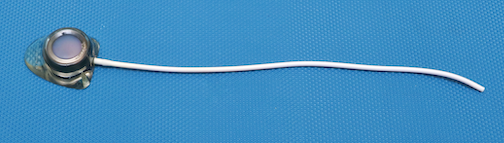
Central line port
Nasogastric feeding tube.
Background: why a central line would be considered
Last reviewed: October 4, 2026
A central line (central venous access device) is a thin, flexible tube whose tip sits in a large vein near the heart. It allows chemotherapy, fluids and other medicines to be given, and blood to be drawn, without repeated needle sticks in the arm. Some chemotherapy drugs irritate small veins and are safer to give into a large, fast-flowing vein, and some are given as a continuous infusion over several days through a small portable pump, which requires central access [1, 2].
In head and neck cancer, many patients receive chemotherapy through ordinary arm IVs, especially weekly or every-three-week cisplatin given with radiation. A central line is more often recommended when fluorouracil (5-FU) is given as a multi-day infusion, as in some regimens for advanced or recurrent cancer, when treatment will last many months, or when arm veins are difficult to access [3, 2] (see chemotherapy and immunotherapy). The sections below describe the types of central lines, what the research shows about their risks, how they are placed and cared for, and when they are removed. A numbered reference list is at the end of the page.
Types of central lines
Implanted port (often called a "port" or "port-a-cath"): a small reservoir, about the size of a large coin, placed under the skin of the upper chest and connected to a catheter that runs into a large vein in the neck or chest. Nothing is outside the body. The port is reached through the skin with a special needle when it is used, and it needs flushing only every few weeks when not in use. Ports are well suited to treatment lasting months [1, 2].
Peripherally inserted central catheter (PICC): a catheter placed through a vein in the upper arm and threaded until its tip lies near the heart. It can be placed quickly without a surgical incision, but part of it stays outside the skin of the arm, it needs weekly flushing and dressing changes, and it cannot get wet during bathing or swimming [4].
Tunneled catheter (such as a Hickman line): a catheter that enters a vein in the neck or chest and is tunneled under the skin to exit on the chest, with a small cuff that anchors it. These are used mostly for very frequent access, such as in blood cancers or bone marrow transplantation [1].
The choice depends on how long treatment will last, which drugs will be given, the condition of the veins, other medical conditions such as kidney disease, and personal preference [4, 2].
Ports compared with PICCs: what the research shows
The CAVA trial (United Kingdom, 1,061 adults receiving chemotherapy for at least 12 weeks) randomly assigned patients to a port, a PICC or a tunneled (Hickman) catheter. Complications of any kind, including infection, blood clots, blockage and mechanical failure, occurred in 32% of patients with a port compared with 47% with a PICC, and in 29% with a port compared with 43% with a Hickman line. The authors concluded that ports are safer and more effective for most patients receiving chemotherapy for solid tumors [5, 6].
A Swedish randomized trial of 399 patients found deep vein thrombosis (a blood clot in the arm or neck vein around the catheter) in 8% of patients with a PICC compared with 1% with a port, and more complications overall with PICCs [7].
Based on this evidence, the 2025 MAGIC-ONC expert panel rated an implanted port or a single-lumen tunneled catheter as appropriate for giving chemotherapy for solid tumors such as head and neck cancer, regardless of how long or how intensive the treatment is [2]. A PICC can still be a reasonable choice when treatment is short, a port cannot be placed quickly, or a minor surgical procedure is not advisable [4, 2].
How a central line is placed
A port is placed in a short outpatient procedure, usually by an interventional radiologist or a surgeon, with local anesthesia and often light sedation. The vein, most often the internal jugular vein in the lower neck, is located with ultrasound, the catheter is guided into position with X-ray imaging, and the port is placed through a small incision below the collarbone. A PICC is placed in the arm, often at the bedside or in the radiology department, also with ultrasound guidance [1, 4].
Using ultrasound to find the vein has made placement safer and has greatly reduced the risk of accidentally puncturing an artery or the lung (pneumothorax) [8, 9]. The ASCO guideline recommends that central lines be placed by experienced operators and advises against routine antibiotics before placement [1]. A port can usually be used the same day or within a few days, once the incision is sealed.
Living with a central line
Flushing. A PICC is flushed and its dressing changed about once a week. A port that is not being used needs flushing only every four to six weeks [4]. A Cochrane review found no clear advantage of heparin over plain saline for keeping catheters open in people with cancer, and the ASCO guideline and MAGIC panel recommend routine flushing with saline [10, 1, 4].
Infection. Fever, chills, or redness, swelling, pain or drainage at the port or PICC site should be reported right away, especially during chemotherapy when infection-fighting white blood cells may be low. Many line infections can be treated with antibiotics without removing the line, but some require removal [1].
Blood clots. Swelling, pain or a feeling of fullness in the arm, neck or face on the side of the line can signal a clot around the catheter. International guidelines do not recommend routine blood thinners just because a central line is in place [1, 11]. When a clot does occur, it is usually treated with a blood thinner for at least three months, and the line can often stay in place if it is still needed and working [11].
Blockage. If a line will not flush or draw blood, a clot-dissolving medicine can often restore it [1].
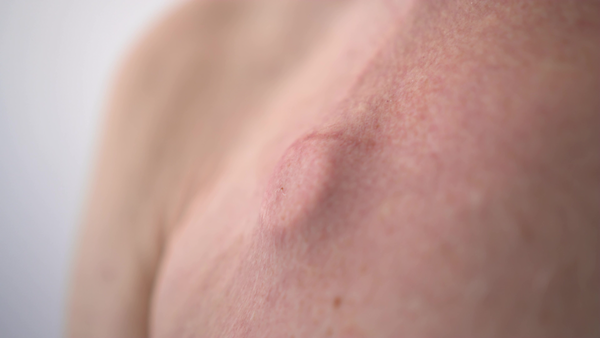
A port allows normal bathing and swimming once the incision has healed, and it is barely visible under clothing.
When the line is removed
A central line is removed when it is no longer needed, usually after chemotherapy is finished and the cancer team is satisfied with the response. It may also be removed for a serious infection or a clot that worsens despite treatment [1]. A PICC is simply pulled out in the clinic. A port is removed in a brief procedure under local anesthesia through the original incision.
Related pages on this site: chemotherapy and immunotherapy, radiation therapy, feeding tube placement, head and neck tumors.
Summary
A central line delivers chemotherapy into a large vein near the heart and is mainly needed for multi-day infusions such as 5-FU, long treatment courses or difficult arm veins [2].
For solid tumors, implanted ports have fewer complications than PICCs or tunneled catheters in randomized trials [5, 7].
Placement is done with ultrasound guidance, which lowers the risk of lung or artery injury [8, 9].
Lines are flushed with saline; ports need flushing only every few weeks when not in use [10, 4].
Fever, redness at the site, or swelling of the arm, neck or face should be reported promptly. Routine blood thinners are not needed [1, 11].
References
Schiffer CA, Mangu PB, Wade JC, et al. Central venous catheter care for the patient with cancer: American Society of Clinical Oncology clinical practice guideline. J Clin Oncol. 2013;31(10):1357-70. doi:10.1200/JCO.2012.45.5733 PubMed 23460705
Major A, Paje DG, Taxbro K, et al. The Michigan Appropriateness Guide for Intravenous Catheters in Adult Patients With Cancer (MAGIC-ONC): Results From a Multispecialty Panel Using the RAND/UCLA Appropriateness Method. Ann Intern Med. 2025;178(12_Supplement):S143-S177. doi:10.7326/ANNALS-25-02523 PubMed 41183333
Vermorken JB, Mesia R, Rivera F, et al. Platinum-based chemotherapy plus cetuximab in head and neck cancer. N Engl J Med. 2008;359(11):1116-27. doi:10.1056/NEJMoa0802656 PubMed 18784101
Chopra V, Flanders SA, Saint S, et al. The Michigan Appropriateness Guide for Intravenous Catheters (MAGIC): Results From a Multispecialty Panel Using the RAND/UCLA Appropriateness Method. Ann Intern Med. 2015;163(6 Suppl):S1-40. doi:10.7326/M15-0744 PubMed 26369828
Moss JG, Wu O, Bodenham AR, et al. Central venous access devices for the delivery of systemic anticancer therapy (CAVA): a randomised controlled trial. Lancet. 2021;398(10298):403-415. doi:10.1016/S0140-6736(21)00766-2 PubMed 34297997
Wu O, McCartney E, Heggie R, et al. Venous access devices for the delivery of long-term chemotherapy: the CAVA three-arm RCT. Health Technol Assess. 2021;25(47):1-126. doi:10.3310/hta25470 PubMed 34318743
Taxbro K, Hammarskjöld F, Thelin B, et al. Clinical impact of peripherally inserted central catheters vs implanted port catheters in patients with cancer: an open-label, randomised, two-centre trial. Br J Anaesth. 2019;122(6):734-741. doi:10.1016/j.bja.2019.01.038 PubMed 31005243
Brass P, Hellmich M, Kolodziej L, et al. Ultrasound guidance versus anatomical landmarks for internal jugular vein catheterization. Cochrane Database Syst Rev. 2015;1(1):CD006962. doi:10.1002/14651858.CD006962.pub2 PubMed 25575244
Teja B, Bosch NA, Diep C, et al. Complication Rates of Central Venous Catheters: A Systematic Review and Meta-Analysis. JAMA Intern Med. 2024;184(5):474-482. doi:10.1001/jamainternmed.2023.8232 PubMed 38436976
López-Briz E, Ruiz Garcia V, Cabello JB, et al. Heparin versus 0.9% sodium chloride locking for prevention of occlusion in central venous catheters in adults. Cochrane Database Syst Rev. 2022;7(7):CD008462. doi:10.1002/14651858.CD008462.pub4 PubMed 35849083
Farge D, Frere C, Connors JM, et al. 2019 international clinical practice guidelines for the treatment and prophylaxis of venous thromboembolism in patients with cancer. Lancet Oncol. 2019;20(10):e566-e581. doi:10.1016/S1470-2045(19)30336-5 PubMed 31492632
Learning Center Main Index:
Throat:
swallowing, tonsils and adenoids, obstructive sleep apnea, voice, oral lesions and mucositis
Aesthetics:
skin regimen, injectables {neuromodulators (e.g., Botox), hyaluronic acid fillers (e.g., Juvederm), and others}, rhinoplasty, chin, facelift, neck lift, and brow lift, blepharoplasty (eyelid surgery), skin resurfacing, scar treatment
Tumors (benign and malignant/cancerous):
general tumor information, thyroid, parathyroid, skin, neck, lymphatics, oropharynx, larynx (voice box), salivary gland, nose and sinus, oral cavity (mouth and lips), nasopharynx, hypopharynx, radiation therapy, chemotherapy and immunotherapy, gastric feeding tube, central line
Nose and Sinus:
rhinoplasty (functional and cosmetic), sinusitis, breathing
Ear:

This page