
Learning Center: Thyroid Cancer Outcomes, Spread to Distant Sites
When papillary or follicular thyroid cancer has spread to the lungs, bones or other organs, the outlook varies widely. Many younger people with small spots that take up radioactive iodine live for decades, while survival is much lower when the spots are large or do not take up iodine. This page describes outlook. It does not compare one treatment with another.
Who this page is about
Last reviewed: November 8, 2026
This page covers adults with papillary or follicular (including oncocytic, formerly called Hürthle cell) thyroid cancer that has spread beyond the neck, most often to the lungs or bones. Distant spread is uncommon. Most people with thyroid cancer never develop it.
Treatment usually starts with total thyroidectomy, followed by radioactive iodine. The Radioactive Iodine Ablation and Radioiodine Uptake pages explain these steps.
Why this page shows outlook, not a treatment comparison
There are no fair comparisons of treatments for distant spread. Nearly everyone who can receive radioactive iodine does, and the people who cannot (because the cancer does not take up iodine, or because of other illnesses) are a very different group. So the graphic below groups people by how the cancer responded, which describes what to expect, rather than by which treatment they chose.
Response to radioactive iodine: the French long-term study
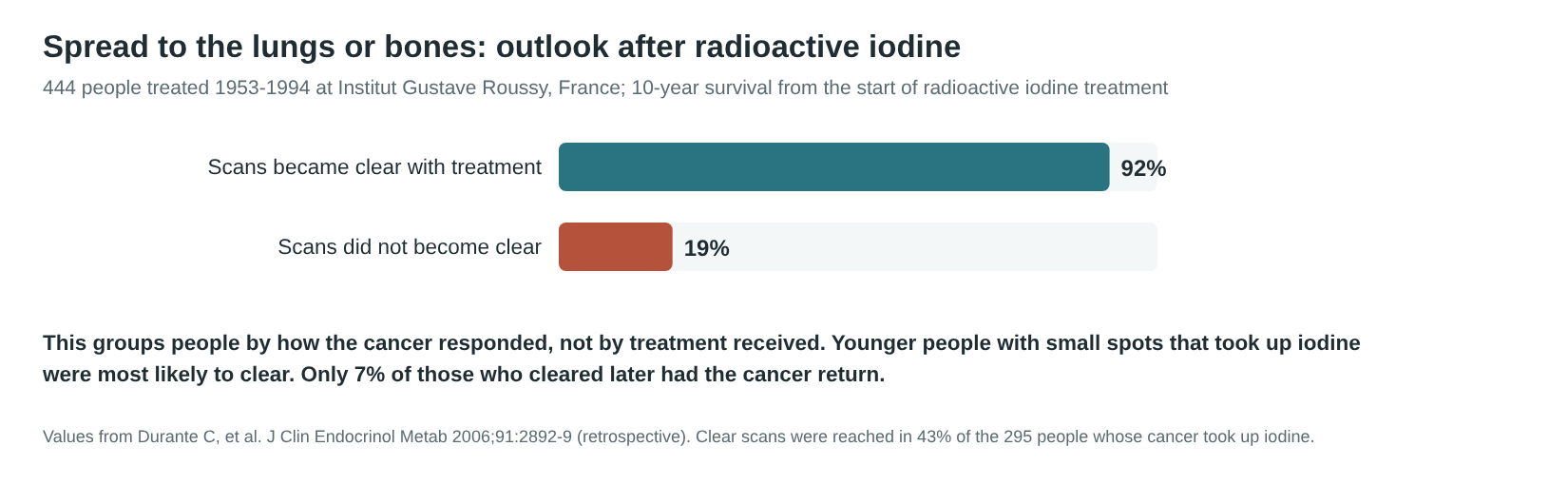
At Institut Gustave Roussy in France, 444 people with distant spread were treated from 1953 to 1994. Half had spread to the lungs only, a quarter to the bones only, and most of the rest to both.[1]
Of the 295 people whose cancer took up radioactive iodine, 43% reached clear scans with treatment.
Clear scans were more likely in people who were younger, had small spots, and had well-differentiated tumors.
Clearing often took time. Almost half of the clear scans came more than 5 years after treatment started.
Of those who reached clear scans, only 7% later had the cancer return.
Alive at 10 years: 92% of those whose scans became clear, and 19% of those whose scans did not.
Survival in national data
A U.S. registry study (SEER) followed 1,991 people who already had distant spread when their thyroid cancer was diagnosed, from 1992 to 2018.[2]
About half were alive without dying of thyroid cancer at 10 years.
This figure did not change across the three decades (50.2%, 47.3% and 52.4%), even though survival for thyroid cancer overall rose slightly over the same period.
Survival was lower in people aged 65 or older (28.1% at 10 years), in men, with larger tumors or lymph node spread, and with oncocytic cancer.
People who were not treated with surgery had lower survival in this study, but they were also older and often had other health problems, so this does not show what surgery itself added.
Other outcomes
| Outcome | What the studies found | Source |
|---|---|---|
| Total radioactive iodine needed to reach clear scans | Most (96%) cleared after a total of 100 to 600 mCi, given in several doses months apart | [1] |
| Return after clear scans | 7% | [1] |
| Age at diagnosis | People 65 and older made up almost half of those with distant spread at diagnosis, and were more likely to receive no treatment or non-surgical treatment | [2] |
Repeated radioactive iodine treatments can cause dry mouth, changes in taste, and, at high total doses, effects on blood counts and fertility. When the cancer no longer takes up iodine, other treatments, including radiation and drug treatments, are considered. Most people in these studies were treated before newer drug treatments came into wide use.
Key points
Thyroid cancer that has spread to distant sites has a wide range of outlooks.
Younger people with small spots that take up radioactive iodine do best; in one large study, those whose scans became clear had 92% survival at 10 years.
Nationally, about half of people with distant spread at diagnosis were alive without dying of thyroid cancer at 10 years, and this has not changed in 30 years.
These numbers describe groups of people, not treatment choices, and cannot predict how any one person will do.
References
Durante C, Haddy N, Baudin E, et al. Long-term outcome of 444 patients with distant metastases from papillary and follicular thyroid carcinoma: benefits and limits of radioiodine therapy. J Clin Endocrinol Metab. 2006;91(8):2892-2899. doi:10.1210/jc.2005-2838 PubMed 16684830
Wilhelm A, Conroy PC, Calthorpe L, et al. Disease-specific survival trends for patients presenting with differentiated thyroid cancer and distant metastases in the United States, 1992-2018. Thyroid. 2023;33(1):63-73. doi:10.1089/thy.2022.0353 PubMed 36413032
Learning Center Main Index:
Throat:
swallowing, tonsils and adenoids, obstructive sleep apnea, voice, oral lesions and mucositis
Aesthetics:
skin regimen, injectables {neuromodulators (e.g., Botox), hyaluronic acid fillers (e.g., Juvederm), and others}, rhinoplasty, chin, facelift, neck lift, and brow lift, blepharoplasty (eyelid surgery), skin resurfacing, scar treatment
Tumors (benign and malignant/cancerous):
general tumor information, thyroid, thyroid cancer outcomes by treatment, parathyroid, skin, neck, lymphatics, oropharynx, larynx (voice box), salivary gland, nose and sinus, inverted papilloma, oral cavity (mouth and lips), nasopharynx, hypopharynx, radiation therapy, chemotherapy and immunotherapy, gastric feeding tube, central line
Nose and Sinus:
rhinoplasty (functional and cosmetic), sinusitis, breathing
Ear:

This page