
Learning Center: Thyroid Cancer Outcomes, Follicular and Oncocytic Cancer
For follicular and oncocytic (formerly Hürthle cell) thyroid cancer, the type of tumor matters more than the choice of treatment. Tumors that barely break through their capsule rarely come back, while tumors that invade many blood vessels or surrounding tissue carry a higher risk. In large studies, the extent of surgery did not change survival, and radioactive iodine did not improve survival from oncocytic cancer.
Who this page is about
Last reviewed: November 8, 2026
This page covers adults with follicular thyroid carcinoma or oncocytic thyroid carcinoma without spread to distant organs at diagnosis. Spread to the lungs or bones is covered on Thyroid Cancer With Distant Spread.
Since 2022, the World Health Organization groups both cancers into three subtypes, based on what the pathologist sees under the microscope:
Minimally invasive: the tumor breaks only slightly through its capsule, without blood vessel invasion.
Encapsulated angioinvasive: the tumor stays mostly within its capsule but has grown into blood vessels.
Widely invasive: the tumor has grown well into the surrounding thyroid or neck tissue.
Because the subtype is known only after the tumor is removed and examined, the extent of surgery is often decided before the subtype is known.
Outlook by subtype
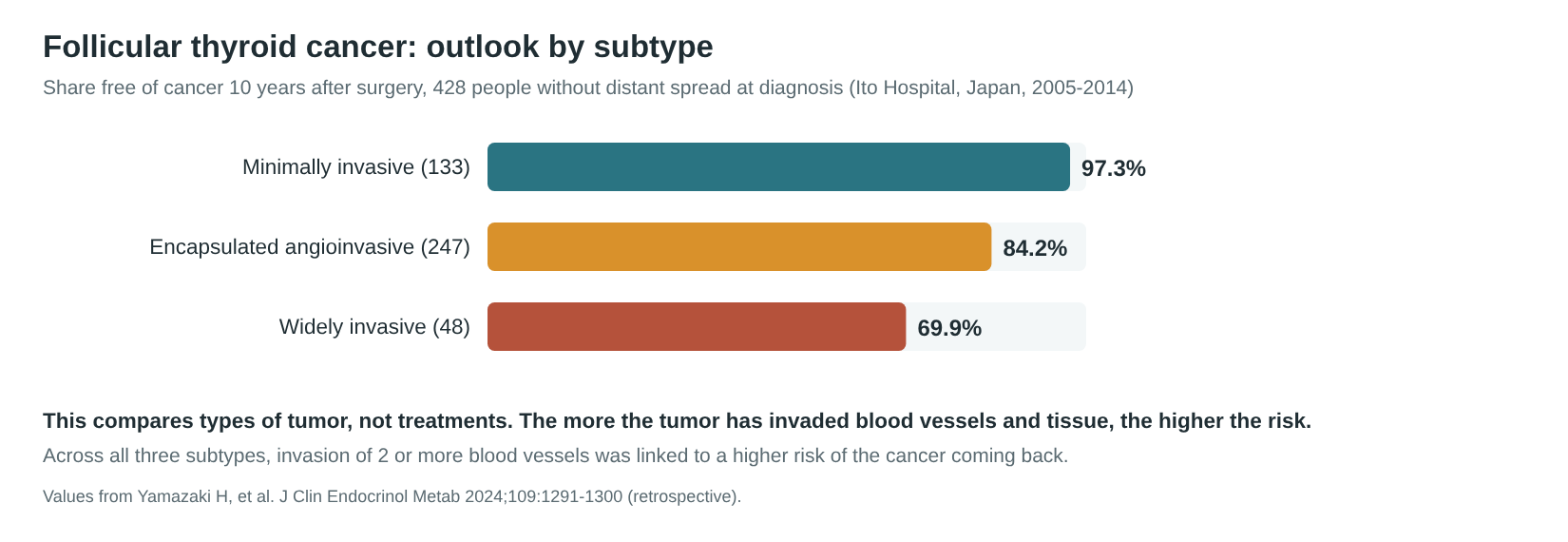
At Ito Hospital in Japan, 428 people with follicular cancer and no distant spread were followed after surgery. The share free of cancer at 10 years was:[1]
97.3% with minimally invasive cancer (133 people)
84.2% with encapsulated angioinvasive cancer (247 people)
69.9% with widely invasive cancer (48 people)
Invasion of 2 or more blood vessels, age 55 or older, a tumor larger than 4 cm, and the subtype itself were each linked to a higher risk of the cancer coming back.[1]
A Dutch study of 52 people with oncocytic cancer found the same pattern for survival. At 10 years, survival without dying of thyroid cancer was 100% for minimally invasive, 92.9% for encapsulated angioinvasive, and 56.5% for widely invasive oncocytic cancer.[2] The numbers are small, but they suggest that the subtype matters as much for oncocytic cancer as for follicular cancer.
Extent of surgery
| Study | People | Result |
|---|---|---|
| National Cancer Database, USA (2004-2015)[3] | 6,871 with follicular cancer 1 to 4 cm; 1,507 had lobectomy and 5,364 total thyroidectomy | Alive at 5 years: 96% after lobectomy and 95.5% after total thyroidectomy (not significant). No difference within any tumor grade. |
| National cancer registry (SEER), USA (2000-2018)[4] | 4,643 with oncocytic (Hürthle cell) cancer | Alive at 10 years: 78.1% overall; alive without dying of thyroid cancer: 91.8%. Surgery was linked to better survival than no surgery, but the extent of surgery made no difference. |
These are studies of past patients, not randomized trials. The Lobectomy vs. Total Thyroidectomy page explains the two operations and their side effects.
Radioactive iodine
| Study | People | Result |
|---|---|---|
| National cancer registry (SEER), USA (2000-2018)[5] | 2,279 with oncocytic cancer after total thyroidectomy | Radioactive iodine was not linked to better survival from thyroid cancer, including in matched groups and in people with larger tumors, lymph node spread, growth outside the thyroid, age 55 or older, or distant spread. |
| Ito Hospital, Japan[6] | 428 with follicular cancer; 216 received radioactive iodine and 212 were observed | Those who received radioactive iodine were older and had more widely invasive tumors, so the two groups could not be compared directly. Among those treated, 56% of those tested had a successful ablation, and none of them died of thyroid cancer or developed distant spread during follow-up. |
Oncocytic cancers often take up less iodine than papillary or follicular cancers, which may explain part of these results. The Radioactive Iodine Ablation page explains the treatment.
Key points
For follicular and oncocytic cancer, the subtype seen under the microscope is the strongest guide to outlook.
Minimally invasive tumors rarely come back; widely invasive tumors carry a much higher risk.
In large national studies, survival was similar after lobectomy or total thyroidectomy.
Radioactive iodine was not linked to better survival from oncocytic cancer; for follicular cancer, fair comparisons are lacking.
All of this evidence comes from studies of past patients.
References
Yamazaki H, Sugino K, Katoh R, et al. Role of the degree of vascular invasion in predicting prognosis of follicular thyroid carcinoma. J Clin Endocrinol Metab. 2024;109(5):1291-1300. doi:10.1210/clinem/dgad689 PubMed 38006314
Stegenga MT, Oudijk L, van Velsen EFS, et al. Impact of reclassification of oncocytic and follicular thyroid carcinoma by the 2022 WHO classification. J Clin Endocrinol Metab. 2025;110(5):e1343-e1350. doi:10.1210/clinem/dgae581 PubMed 39166490
Kethidi N, Vedula S, Shihora D, et al. Extent of surgery for follicular thyroid carcinoma. Laryngoscope. 2023;133(4):993-999. doi:10.1002/lary.30441 PubMed 36317788
Humphreys BM, Memeh KO, Funkhouser A, et al. Prognostic factors and survival analysis of Hurthle cell carcinoma: a population-based study. Surgery. 2022;172(5):1379-1384. doi:10.1016/j.surg.2022.07.007 PubMed 36038373
Wang X, Zheng X, Zhu J, et al. Radioactive iodine therapy does not improve cancer-specific survival in Hürthle cell carcinoma of the thyroid. J Clin Endocrinol Metab. 2022;107(11):3144-3151. doi:10.1210/clinem/dgac448 PubMed 35908290
Yamazaki H, Sugino K, Katoh R, et al. Clinical significance of successful ablation in follicular thyroid carcinoma. J Clin Endocrinol Metab. 2025;111(1):84-92. doi:10.1210/clinem/dgaf326 PubMed 40464652
Learning Center Main Index:
Throat:
swallowing, tonsils and adenoids, obstructive sleep apnea, voice, oral lesions and mucositis
Aesthetics:
skin regimen, injectables {neuromodulators (e.g., Botox), hyaluronic acid fillers (e.g., Juvederm), and others}, rhinoplasty, chin, facelift, neck lift, and brow lift, blepharoplasty (eyelid surgery), skin resurfacing, scar treatment
Tumors (benign and malignant/cancerous):
general tumor information, thyroid, thyroid cancer outcomes by treatment, parathyroid, skin, neck, lymphatics, oropharynx, larynx (voice box), salivary gland, nose and sinus, inverted papilloma, oral cavity (mouth and lips), nasopharynx, hypopharynx, radiation therapy, chemotherapy and immunotherapy, gastric feeding tube, central line
Nose and Sinus:
rhinoplasty (functional and cosmetic), sinusitis, breathing
Ear:

This page