

Learning Center: Thyroid Cancer Outcomes, Lobectomy vs. Total Thyroidectomy
For papillary thyroid cancer up to 4 cm that is confined to the thyroid and has no lymph node spread, people who had half the thyroid removed (lobectomy) and people who had the whole thyroid removed (total thyroidectomy) had nearly identical survival in large studies. The differences between the two operations show up instead in recurrence in the remaining lobe, the chance of a second operation, complications, and the need for thyroid hormone pills.
The two operations
Last reviewed: November 8, 2026
Lobectomy (also called hemithyroidectomy) removes the lobe that contains the cancer, along with the isthmus, the bridge of tissue joining the two lobes. The other lobe stays in place and often keeps making enough thyroid hormone.
Total thyroidectomy removes the whole thyroid. Lifelong thyroid hormone pills are needed afterward.
The Extent of Thyroid Surgery page describes both operations in more detail.
Who these results apply to
The studies on this page included adults with papillary thyroid cancer (and, in one study, a small number of follicular and oncocytic cancers) that was:
1 to 4 cm in size (some studies included smaller tumors)
confined to the thyroid, with no obvious growth into surrounding tissue
without lymph node spread seen before or during surgery
without spread to distant organs
Tumors under 1 cm (microcarcinomas), cancers with lymph node spread, and more aggressive types are discussed on other pages. See Thyroid Cancer Outcomes by Treatment.
Survival: the lines sit on top of each other
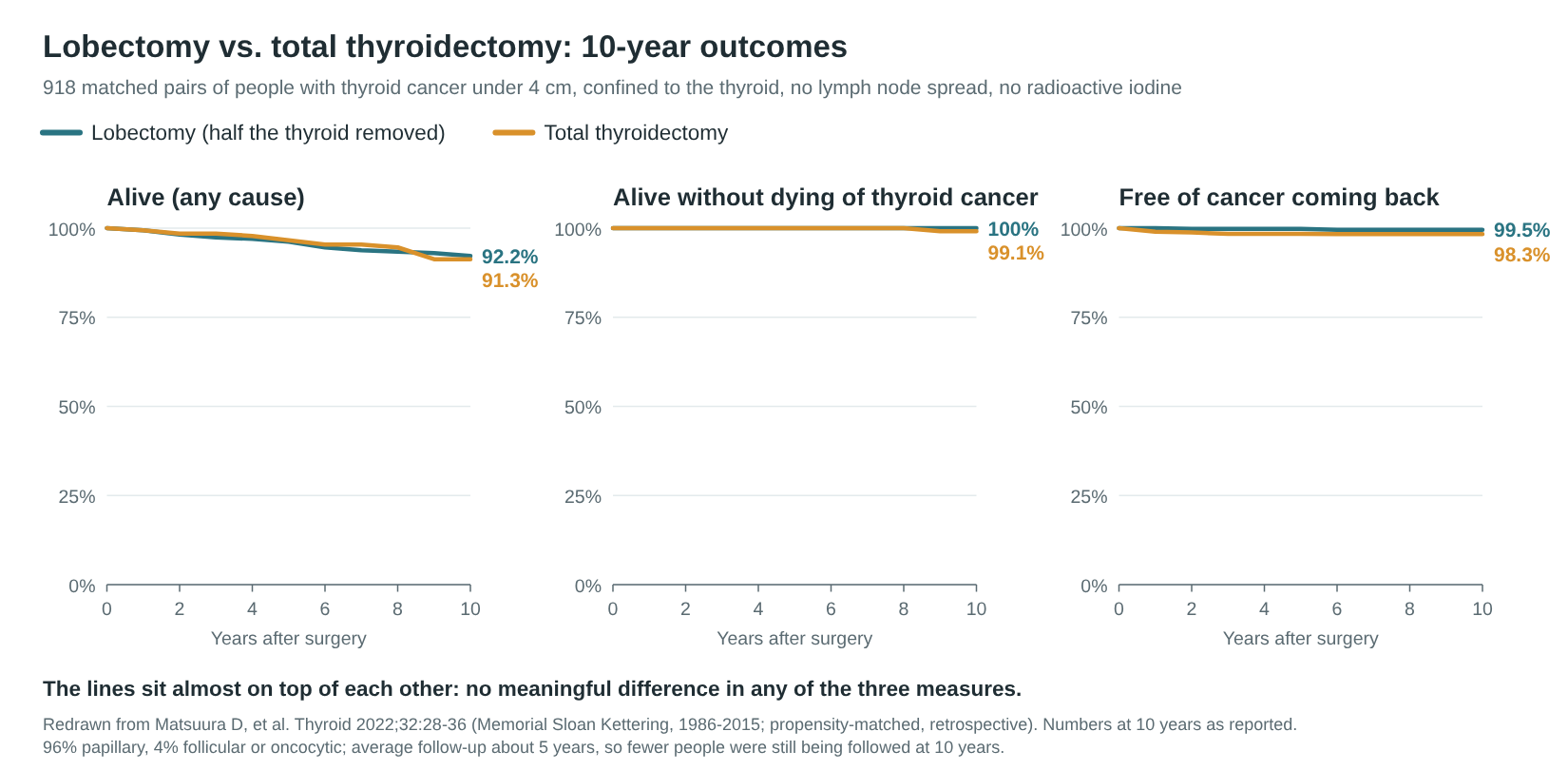
At Memorial Sloan Kettering Cancer Center, researchers matched 918 people who had lobectomy with 918 similar people who had total thyroidectomy, pairing them by age, sex, tumor type, tumor size and risk group. None of them received radioactive iodine. At 10 years:
Alive from any cause: 92.2% after lobectomy and 91.3% after total thyroidectomy.
Alive without dying of thyroid cancer: 100% and 99.1%. One person in the total thyroidectomy group died of thyroid cancer.
Free of cancer coming back: 99.5% and 98.3%. Five people in the lobectomy group and ten in the total thyroidectomy group had a recurrence.
None of these differences was statistically significant.[1] Nearly all deaths in the study were from causes other than thyroid cancer, and age over 55 was the only factor linked to overall survival.
The same pattern in national data
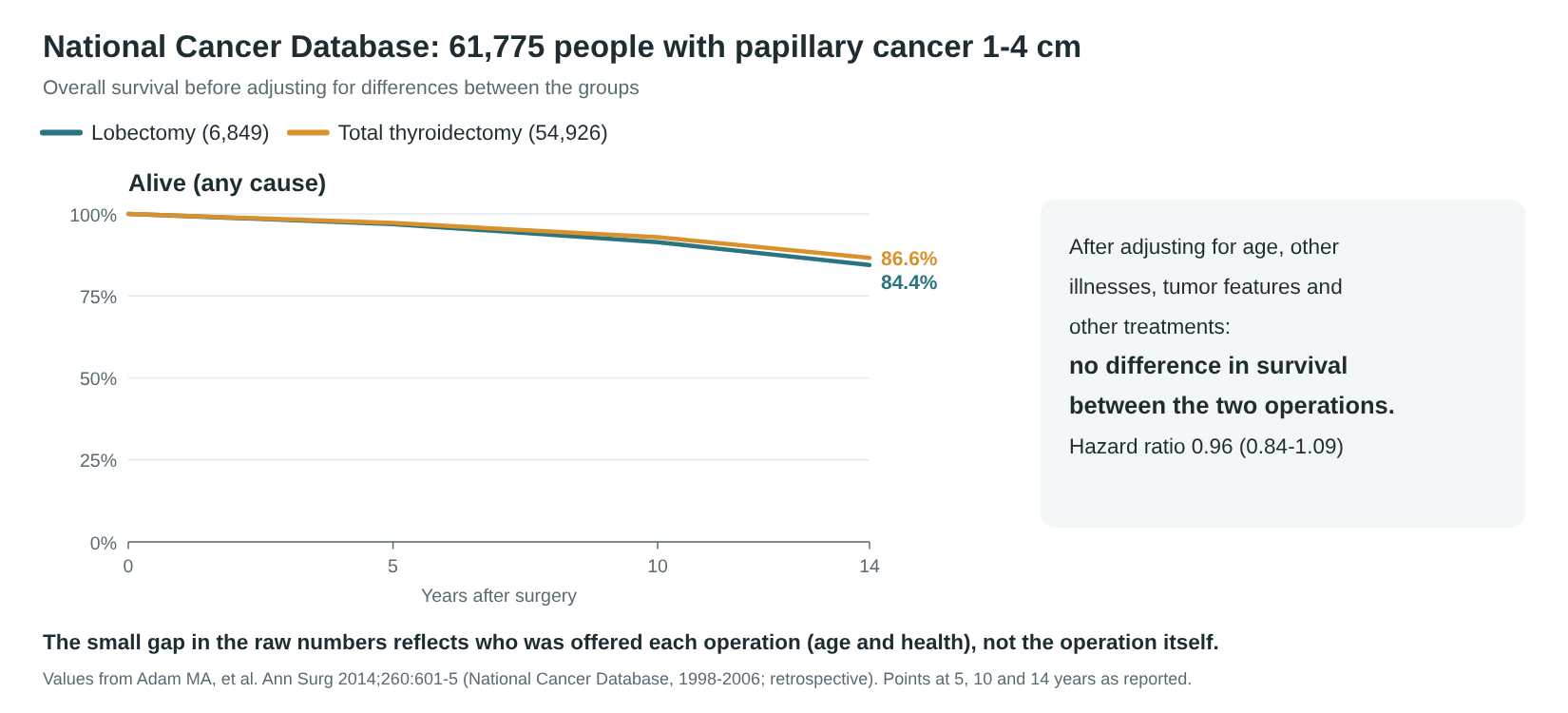
The National Cancer Database looked at 61,775 people with papillary cancer 1 to 4 cm treated from 1998 to 2006. In the raw numbers, people who had total thyroidectomy lived slightly longer (86.6% vs. 84.4% alive at 14 years). After adjusting for age, other illnesses, and tumor features, the difference disappeared (hazard ratio 0.96, meaning essentially equal risk).[2] An earlier analysis of the same database that did not adjust for these factors had suggested an advantage for total thyroidectomy.[3]
Other large studies, including national cancer registry (SEER) analyses and a long-term study of 1,088 people treated with lobectomy in Japan, reached similar conclusions.[4,5] A matched study of 381 pairs in Korea, followed for a median of almost 10 years, found no difference in recurrence between the two operations for tumors 1 to 2 cm or 2 to 4 cm.[6] Another Korean hospital study found more recurrences after lobectomy (9.4% vs. 5.7%), but many of its patients had lymph node spread or growth outside the thyroid, and deaths from thyroid cancer were not higher after lobectomy. For tumors that were single, confined to the thyroid, and without lymph node spread, the extent of surgery made no difference.[7]
Recurrence by tumor size
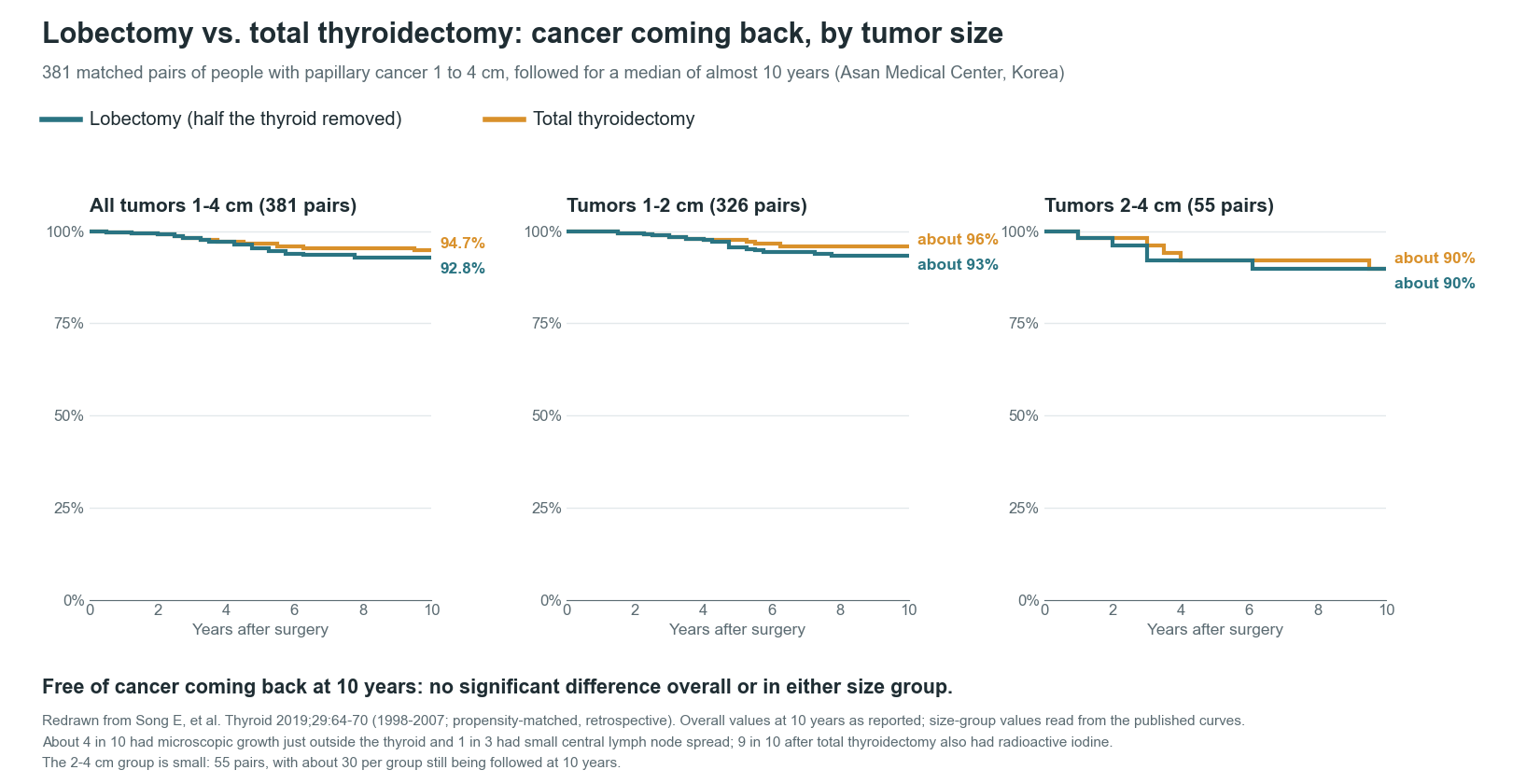
At Asan Medical Center in Korea, researchers matched 381 people who had lobectomy with 381 similar people who had total thyroidectomy. The pairs were matched by age, sex, tumor size, growth just outside the thyroid, number of tumors, and central lymph node spread, and followed for a median of almost 10 years.[6]
Free of cancer coming back at 10 years: 92.8% after lobectomy and 94.7% after total thyroidectomy.
Number with a recurrence: 24 (6.3%) after lobectomy and 18 (4.7%) after total thyroidectomy, a difference that was not statistically significant.
By tumor size: no significant difference for tumors 1 to 2 cm (326 pairs) or 2 to 4 cm (55 pairs).
Where the cancer came back differed. After lobectomy, most recurrences (18 of 24) were in the remaining lobe, sometimes along with lymph nodes in the side of the neck. After total thyroidectomy, most (15 of 18) were in lymph nodes in the side of the neck. This group was not limited to the lowest-risk cancers: about 4 in 10 had microscopic growth just outside the thyroid, and about 1 in 3 had small central lymph node spread. Nine in ten of those who had total thyroidectomy also received radioactive iodine.[6]
Recurrence: where the differences are
After lobectomy, a new cancer can appear in the remaining lobe. In a combined analysis of 17 studies of small papillary cancers, about 2.3% of people developed cancer in the other lobe after lobectomy. Overall recurrence was 3.8% after lobectomy and 1.0% after total thyroidectomy, but recurrence in the neck and thyroid bed was no different.[8] A new cancer in the remaining lobe is usually found on ultrasound during routine follow-up and treated with surgery to remove the rest of the thyroid.
Follow-up after either operation includes neck ultrasound and blood tests. The Monitoring After Thyroid Cancer Surgery page explains this.
Other outcomes
| Outcome | Lobectomy | Total thyroidectomy | Source |
|---|---|---|---|
| Temporary low calcium (parathyroid stunning) | 2.2% | 21.3% | [8] |
| Permanent low calcium | 0% | 1.8% | [8] |
| Temporary hoarseness from nerve weakness | 3.3% | 4.5% | [8] |
| Second operation to remove the rest of the thyroid (completion thyroidectomy) | About 1 in 10 to 1 in 3, usually because the final pathology shows higher-risk features | Not applicable | [9] |
| Thyroid hormone pills needed | About 3 in 10 overall, more often in women and in people with Hashimoto's thyroiditis or a higher TSH level before surgery | All, for life | [10] |
| Quality of life | Better at 1 and 3 months | More problems at 1 and 3 months (anxiety, voice, tingling) | [11] |
| Quality of life at 6 to 12 months | Nearly all differences gone | Nearly all differences gone | [11] |
The complication rates come mostly from studies of tumors under 1 cm, where the operations are the same, and from experienced surgeons. Rates vary by surgeon and hospital. See Recovery After Thyroidectomy and Hypoparathyroidism.
Why total thyroidectomy is still sometimes chosen
A larger operation may be favored when there are nodules in the other lobe, a strong family history, prior radiation to the neck, lymph node spread, growth outside the thyroid, or a plan for radioactive iodine. Personal preference matters too: some people prefer to avoid a possible second operation, and others prefer to keep half of their thyroid. Considerations in the Extent of Thyroidectomy covers these factors.
Key points
For papillary cancer up to 4 cm confined to the thyroid, survival after lobectomy and after total thyroidectomy is nearly identical.
Deaths from thyroid cancer were rare after either operation.
Lobectomy carries a small chance of cancer in the remaining lobe and a chance of a second operation.
Total thyroidectomy carries more temporary and permanent low-calcium problems and always requires thyroid hormone pills.
Most of this evidence comes from studies of past patients, not randomized trials.
References
Matsuura D, Yuan A, Harris V, et al. Surgical management of low-/intermediate-risk node negative thyroid cancer: a single-institution study using propensity matching analysis to compare thyroid lobectomy and total thyroidectomy. Thyroid. 2022;32(1):28-36. doi:10.1089/thy.2021.0356 PubMed 34861772
Adam MA, Pura J, Gu L, et al. Extent of surgery for papillary thyroid cancer is not associated with survival: an analysis of 61,775 patients. Ann Surg. 2014;260(4):601-605. doi:10.1097/SLA.0000000000000925 PubMed 25203876
Bilimoria KY, Bentrem DJ, Ko CY, et al. Extent of surgery affects survival for papillary thyroid cancer. Ann Surg. 2007;246(3):375-381. doi:10.1097/SLA.0b013e31814697d9 PubMed 17717441
Mendelsohn AH, Elashoff DA, Abemayor E, St John MA. Surgery for papillary thyroid carcinoma: is lobectomy enough? Arch Otolaryngol Head Neck Surg. 2010;136(11):1055-1061. doi:10.1001/archoto.2010.181 PubMed 21079156
Matsuzu K, Sugino K, Masudo K, et al. Thyroid lobectomy for papillary thyroid cancer: long-term follow-up study of 1,088 cases. World J Surg. 2014;38(1):68-79. doi:10.1007/s00268-013-2224-1 PubMed 24081532
Song E, Han M, Oh HS, et al. Lobectomy is feasible for 1-4 cm papillary thyroid carcinomas: a 10-year propensity score matched-pair analysis on recurrence. Thyroid. 2019;29(1):64-70. doi:10.1089/thy.2018.0554 PubMed 30375260
Choi JB, Lee SG, Kim MJ, et al. Oncologic outcomes in patients with 1-cm to 4-cm differentiated thyroid carcinoma according to extent of thyroidectomy. Head Neck. 2019;41(1):56-63. doi:10.1002/hed.25356 PubMed 30536465
Hsiao V, Light TJ, Adil AA, et al. Complication rates of total thyroidectomy vs hemithyroidectomy for treatment of papillary thyroid microcarcinoma: a systematic review and meta-analysis. JAMA Otolaryngol Head Neck Surg. 2022;148(6):531-539. doi:10.1001/jamaoto.2022.0621 PubMed 35511129
Vargas-Pinto S, Romero Arenas MA. Lobectomy compared to total thyroidectomy for low-risk papillary thyroid cancer: a systematic review. J Surg Res. 2019;242:244-251. doi:10.1016/j.jss.2019.04.036 PubMed 31103828
Li Z, Qiu Y, Fei Y, et al. Prevalence of and risk factors for hypothyroidism after hemithyroidectomy: a systematic review and meta-analysis. Endocrine. 2020;70(2):243-255. doi:10.1007/s12020-020-02410-5 PubMed 32638212
Chen W, Li J, Peng S, et al. Association of total thyroidectomy or thyroid lobectomy with the quality of life in patients with differentiated thyroid cancer with low to intermediate risk of recurrence. JAMA Surg. 2022;157(3):200-209. doi:10.1001/jamasurg.2021.6442 PubMed 34935859
Learning Center Main Index:
Throat:
swallowing, tonsils and adenoids, obstructive sleep apnea, voice, oral lesions and mucositis
Aesthetics:
skin regimen, injectables {neuromodulators (e.g., Botox), hyaluronic acid fillers (e.g., Juvederm), and others}, rhinoplasty, chin, facelift, neck lift, and brow lift, blepharoplasty (eyelid surgery), skin resurfacing, scar treatment
Tumors (benign and malignant/cancerous):
general tumor information, thyroid, thyroid cancer outcomes by treatment, parathyroid, skin, neck, lymphatics, oropharynx, larynx (voice box), salivary gland, nose and sinus, inverted papilloma, oral cavity (mouth and lips), nasopharynx, hypopharynx, radiation therapy, chemotherapy and immunotherapy, gastric feeding tube, central line
Nose and Sinus:
rhinoplasty (functional and cosmetic), sinusitis, breathing
Ear:

This page