

Learning Center: Thyroid Cancer Outcomes, Central Neck Lymph Node Removal
When papillary thyroid cancer shows no lymph node spread on ultrasound or during surgery, some surgeons also remove the lymph nodes in the central neck "just in case." Randomized trials found that this extra step did not lower the chance of the cancer coming back, while it did raise the chance of permanent low calcium from parathyroid gland injury.
What a central neck dissection is
Last reviewed: November 8, 2026
The central neck is the area around the thyroid, voice box and windpipe, between the two carotid arteries. It holds the lymph nodes that papillary thyroid cancer reaches first. It also holds the parathyroid glands, which control calcium, and the recurrent laryngeal nerves, which move the vocal cords.
A therapeutic central neck dissection removes these nodes when cancer is already known or seen in them. A prophylactic (or elective) central neck dissection removes them when no cancer is seen, in case some is present under the microscope. This page is about the prophylactic kind.
Who these results apply to
The trials included adults with papillary thyroid cancer who had a total thyroidectomy and had no enlarged or suspicious lymph nodes on ultrasound before surgery or on examination during surgery. Most tumors were under 4 cm.
Recurrence: about the same either way
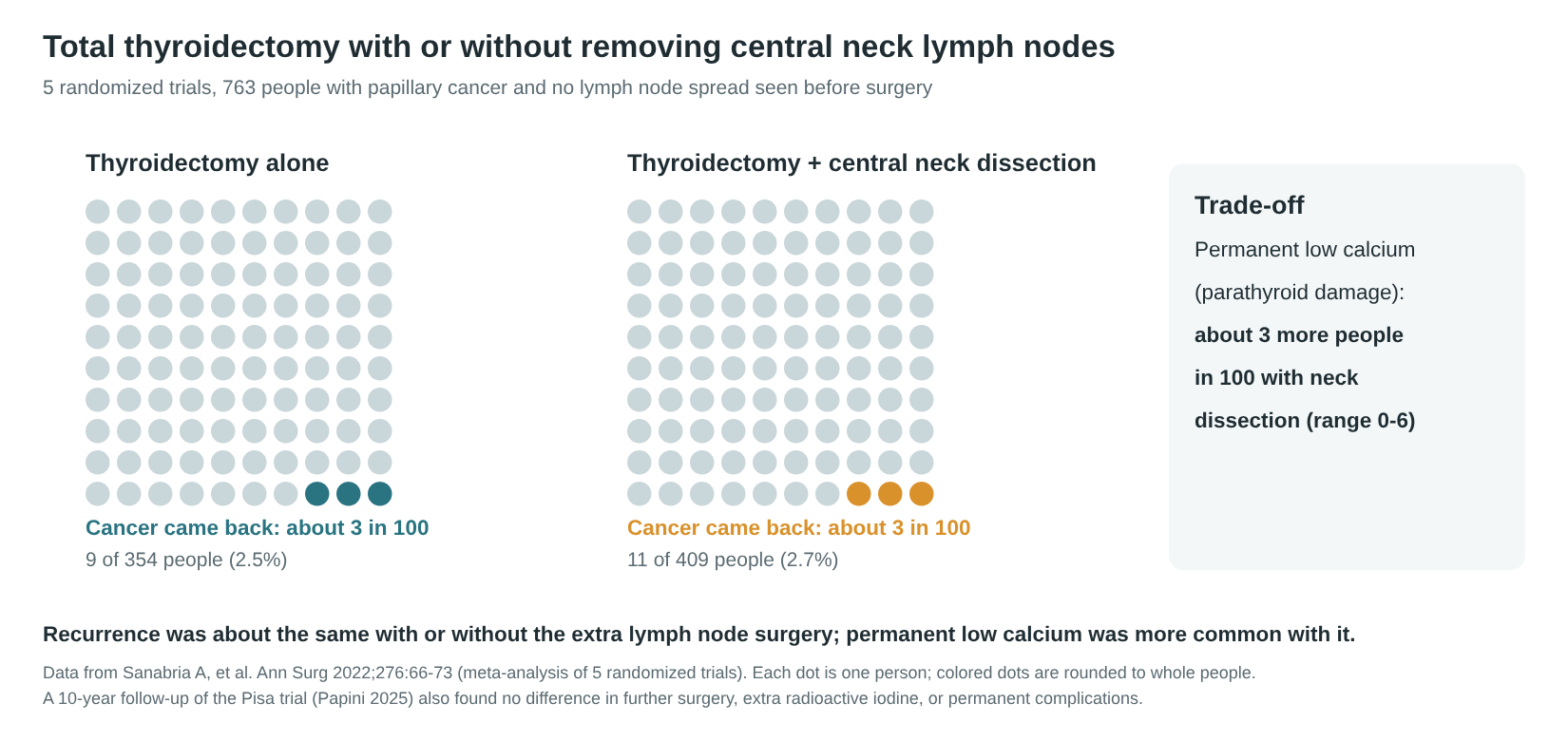
A combined analysis of five randomized trials included 763 people. The cancer came back in the neck or elsewhere in:[1]
9 of 354 people (2.5%) who had total thyroidectomy alone
11 of 409 people (2.7%) who also had a central neck dissection
The difference was zero percentage points (range -2 to +2). Based on these numbers, about 500 people would need the extra surgery to prevent one recurrence. Blood-test (thyroglobulin) recurrences were also no different.
Individual trials showed the same pattern:
Pisa, Italy: 181 people followed for 5 years, then over 10 years. No difference in outcome, need for further surgery, or extra radioactive iodine at 10 years.[2,3]
Wisconsin, USA: 60 people. Thyroglobulin levels and neck ultrasounds at 1 year were the same in both groups, even though about 1 in 4 dissections found small cancer deposits (all 6 mm or less).[4]
China, two hospitals: 570 people followed for a median of 5 years. Lymph node recurrence was 7.3% without and 4.6% with the dissection, a difference that was not statistically significant.[5]
Studies of past patients (not randomized) have sometimes found fewer neck recurrences with the dissection. In those studies the people who had a dissection often also received more radioactive iodine and were treated in different years, which makes a fair comparison difficult.
What the extra surgery finds
Small cancer deposits are found in the central nodes in roughly a quarter to a half of people who have a prophylactic dissection.[2,4] Finding them can change the cancer's stage and sometimes the plan for radioactive iodine. In the Pisa trial, people without the dissection needed more radioactive iodine treatments over the first 5 years, but the difference was gone by 10 years.[2,3]
Other outcomes
| Outcome | Total thyroidectomy alone | Plus central neck dissection | Source |
|---|---|---|---|
| Permanent low calcium (pooled trials) | Baseline | About 3 more people per 100 (range 0 to 6) | [1] |
| Permanent low calcium (Pisa trial, 5 years) | 8.0% | 19.4% | [2] |
| Permanent low calcium (Pisa trial, 10 years) | No significant difference; more parathyroid glands were removed with the dissection | [3] | |
| Overall complications (China trial) | 6.6% | 19.1% | [5] |
| Temporary low parathyroid hormone after surgery (Wisconsin trial) | 33.3% | 24.1% (not significant) | [4] |
| Temporary nerve weakness (Wisconsin trial) | 13.3% | 10.3% (not significant) | [4] |
| Permanent vocal cord weakness (Pisa, 10 years) | No difference | No difference | [3] |
| More radioactive iodine treatments | More often in the first 5 years | Fewer in the first 5 years; equal at 10 years | [2,3] |
Complication rates vary with the surgeon's experience. See Hypoparathyroidism and Recovery After Thyroidectomy.
Questions still being studied
A larger French trial (ESTIMABL3) is comparing the two approaches in about 600 people and includes quality of life. Its results have not yet been reported.
Key points
For papillary thyroid cancer without visible lymph node spread, removing the central neck nodes did not reduce recurrence in randomized trials.
The extra surgery raised the risk of low calcium, including permanent low calcium in some studies.
Microscopic cancer in these nodes is common but rarely seems to cause problems later.
When lymph nodes are known to contain cancer, removing them is a different situation and is not covered here.
References
Sanabria A, Betancourt-Agüero C, Sánchez-Delgado JG, García-Lozano C. Prophylactic central neck lymph node dissection in low-risk thyroid carcinoma patients does not decrease the incidence of locoregional recurrence: a meta-analysis of randomized trials. Ann Surg. 2022;276(1):66-73. doi:10.1097/SLA.0000000000005388 PubMed 35129470
Viola D, Materazzi G, Valerio L, et al. Prophylactic central compartment lymph node dissection in papillary thyroid carcinoma: clinical implications derived from the first prospective randomized controlled single institution study. J Clin Endocrinol Metab. 2015;100(4):1316-1324. doi:10.1210/jc.2014-3825 PubMed 25590215
Papini P, Rossi L, Matrone A, et al. Prophylactic central neck dissection in clinically node-negative papillary thyroid carcinoma: 10-year impact on surgical and oncologic outcomes. Surgery. 2025;181:109258. doi:10.1016/j.surg.2025.109258 PubMed 39983243
Sippel RS, Robbins SE, Poehls JL, et al. A randomized controlled clinical trial: no clear benefit to prophylactic central neck dissection in patients with clinically node negative papillary thyroid cancer. Ann Surg. 2020;272(3):496-503. doi:10.1097/SLA.0000000000004345 PubMed 33759836
Yuan Q, Yang Y, Li C, et al. Prophylactic central neck dissection based on preoperative imaging and intraoperative surgeon's palpation versus total thyroidectomy alone for papillary thyroid cancer. J Surg Res. 2023;290:126-132. doi:10.1016/j.jss.2023.03.035 PubMed 37263083
Learning Center Main Index:
Throat:
swallowing, tonsils and adenoids, obstructive sleep apnea, voice, oral lesions and mucositis
Aesthetics:
skin regimen, injectables {neuromodulators (e.g., Botox), hyaluronic acid fillers (e.g., Juvederm), and others}, rhinoplasty, chin, facelift, neck lift, and brow lift, blepharoplasty (eyelid surgery), skin resurfacing, scar treatment
Tumors (benign and malignant/cancerous):
general tumor information, thyroid, thyroid cancer outcomes by treatment, parathyroid, skin, neck, lymphatics, oropharynx, larynx (voice box), salivary gland, nose and sinus, inverted papilloma, oral cavity (mouth and lips), nasopharynx, hypopharynx, radiation therapy, chemotherapy and immunotherapy, gastric feeding tube, central line
Nose and Sinus:
rhinoplasty (functional and cosmetic), sinusitis, breathing
Ear:

This page