
Learning Center: Thyroid Cancer Outcomes, Radioactive Iodine for Low-Risk Cancer
For many years, radioactive iodine was given routinely after total thyroidectomy for thyroid cancer. Two randomized trials in people with low-risk cancer found that skipping it did not increase recurrence, no one in either trial died of thyroid cancer, and quality of life was the same. This is one of the few thyroid cancer questions answered by randomized trials.
What radioactive iodine does
Last reviewed: November 8, 2026
Thyroid cells take up iodine. After total thyroidectomy, a dose of radioactive iodine (I-131) can destroy remaining normal thyroid tissue (called remnant ablation) and any microscopic cancer cells that take up iodine. It is given as a capsule or liquid. Afterward, close contact with others, especially children and pregnant women, is limited for several days. The Radioactive Iodine Ablation page explains the treatment.
Who these results apply to
The two trials included adults who had a total thyroidectomy with all visible cancer removed, and who had:
IoN (United Kingdom): papillary or follicular cancer up to 4 cm, or slightly larger tumors limited to small amounts of growth outside the thyroid under the older staging system, with no lymph node spread or only small central neck node spread.[1]
ESTIMABL2 (France): papillary or follicular cancer up to 2 cm, without lymph node spread, and a normal neck ultrasound after surgery. About 96% had papillary cancer.[2,3]
People with larger tumors, extensive lymph node spread, growth into neck structures, or distant spread were not included. See Radioactive Iodine for Intermediate-Risk Cancer.
Recurrence: the IoN trial
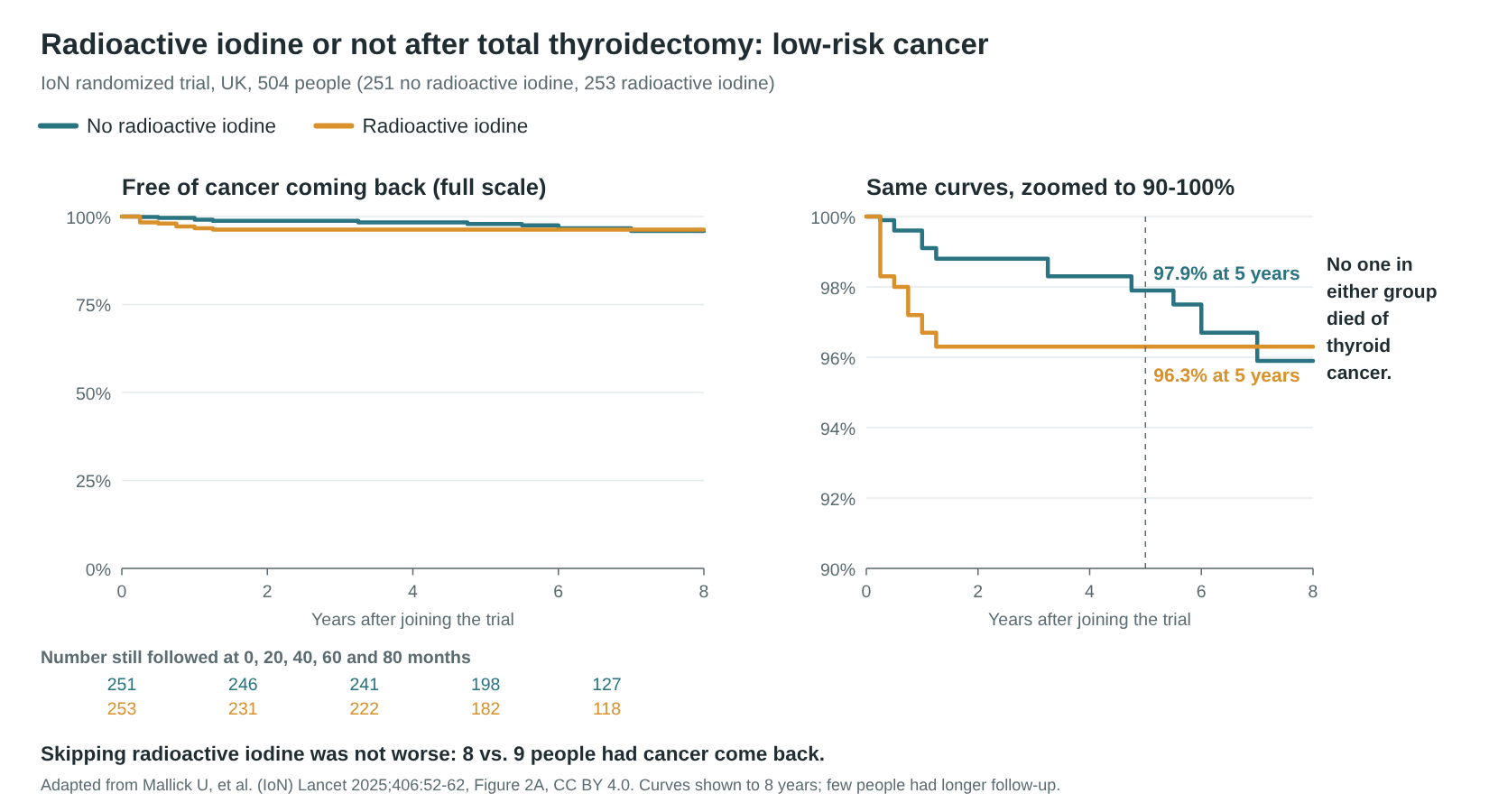
IoN randomly assigned 504 people to radioactive iodine (253) or no radioactive iodine (251) after surgery and followed them for a median of almost 7 years.[1]
Free of cancer coming back at 5 years: 97.9% without radioactive iodine and 96.3% with it.
Number with a recurrence: 8 without and 9 with radioactive iodine.
Deaths from thyroid cancer: none in either group.
Skipping radioactive iodine was "non-inferior," meaning it was not meaningfully worse by the trial's pre-set standard. On the full 0-100% scale the two lines nearly overlap. In the zoomed view, the curves cross over time; these small differences come from a handful of people and are within the range expected by chance.
Recurrence was more common in people with slightly larger tumors growing just outside the thyroid (9%) or with central lymph node spread (13%) than in others (2 to 3%), but it was similar with or without radioactive iodine in these groups. The trial authors did not draw conclusions for these smaller subgroups.[1]
Recurrence: the ESTIMABL2 trial
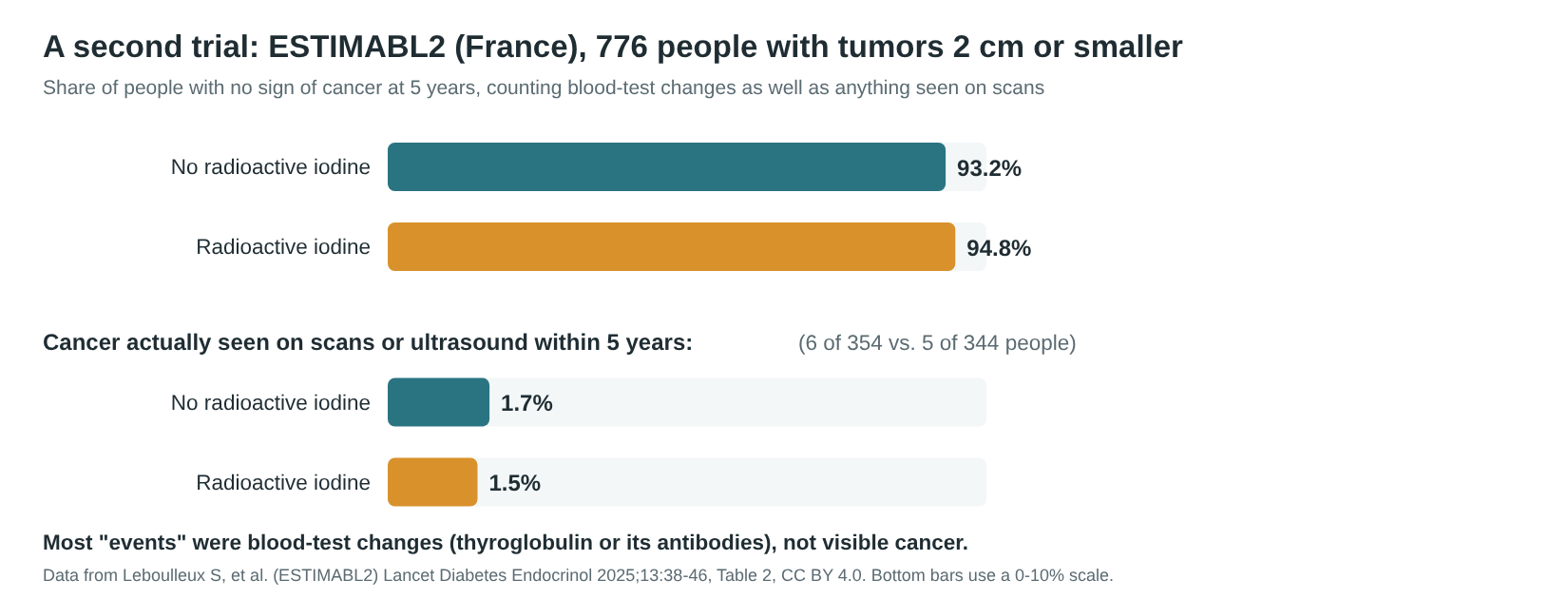
ESTIMABL2 randomly assigned 776 people with tumors 2 cm or smaller. At 5 years, 93.2% of those without radioactive iodine and 94.8% of those with it had no "event," which was also judged non-inferior.[3]
ESTIMABL2 counted blood-test changes (a rising thyroglobulin or thyroglobulin antibodies) as events, as well as cancer seen on ultrasound or scans. Most events were blood-test changes. Cancer actually seen on imaging occurred in 6 of 354 people without radioactive iodine and 5 of 344 people with it (about 1.5 to 1.7%).[3]
Long-term studies of past patients
A French study of 1,298 people with low-risk cancer followed for a median of 10 years found no difference in survival or in remaining disease-free between those who did and did not receive radioactive iodine, after accounting for differences between the groups.[4]
Other outcomes
| Outcome | No radioactive iodine | Radioactive iodine | Source |
|---|---|---|---|
| Any of the expected side effects in the first 2 months (fatigue, dry mouth, taste change, nausea and others) | 41% | 44% | [1] |
| Fatigue | 24% | 28% | [1] |
| Change in taste | 1% | 4% | [1] |
| Nausea | 3% | 6% | [1] |
| Salivary gland inflammation | 0% | 1% | [1] |
| Quality of life (EORTC QLQ-C30 questionnaire) | No difference | No difference | [1] |
| Quality of life, anxiety and fear of recurrence | Similar | Similar | [2] |
| Hospital stay and avoiding close contact with children afterward | Not needed | Needed for several days | [1] |
Many of these symptoms were common in both groups, which suggests that some come from recovering from surgery or adjusting thyroid hormone, not from the radioactive iodine itself.
How follow-up differs without radioactive iodine
Without radioactive iodine, some normal thyroid tissue usually remains, so thyroglobulin blood levels are interpreted differently. Follow-up relies on neck ultrasound and on watching the trend of thyroglobulin over time. In ESTIMABL2, the few people with recurrence in the no-radioactive-iodine group were treated with surgery, radioactive iodine, or both.[3] The Monitoring After Thyroid Cancer Surgery page explains follow-up.
Key points
Two randomized trials found that skipping radioactive iodine after total thyroidectomy for low-risk thyroid cancer did not meaningfully increase recurrence.
No one in either trial died of thyroid cancer.
Side effects and quality of life were similar, but radioactive iodine requires several days of limited close contact with others.
These results apply to low-risk cancer; the evidence for higher-risk cancer is different.
References
Mallick U, Newbold K, Beasley M, et al. Thyroidectomy with or without postoperative radioiodine for patients with low-risk differentiated thyroid cancer in the UK (IoN): a randomised, multicentre, non-inferiority trial. Lancet. 2025;406(10498):52-62. doi:10.1016/S0140-6736(25)00629-4 PubMed 40543520
Leboulleux S, Bournaud C, Chougnet CN, et al. Thyroidectomy without radioiodine in patients with low-risk thyroid cancer. N Engl J Med. 2022;386(10):923-932. doi:10.1056/NEJMoa2111953 PubMed 35263518
Leboulleux S, Bournaud C, Chougnet CN, et al. Thyroidectomy without radioiodine in patients with low-risk thyroid cancer: 5 years of follow-up of the prospective randomised ESTIMABL2 trial. Lancet Diabetes Endocrinol. 2025;13(1):38-46. doi:10.1016/S2213-8587(24)00276-6 PubMed 39586309
Schvartz C, Bonnetain F, Dabakuyo S, et al. Impact on overall survival of radioactive iodine in low-risk differentiated thyroid cancer patients. J Clin Endocrinol Metab. 2012;97(5):1526-1535. doi:10.1210/jc.2011-2512 PubMed 22344193
Learning Center Main Index:
Throat:
swallowing, tonsils and adenoids, obstructive sleep apnea, voice, oral lesions and mucositis
Aesthetics:
skin regimen, injectables {neuromodulators (e.g., Botox), hyaluronic acid fillers (e.g., Juvederm), and others}, rhinoplasty, chin, facelift, neck lift, and brow lift, blepharoplasty (eyelid surgery), skin resurfacing, scar treatment
Tumors (benign and malignant/cancerous):
general tumor information, thyroid, thyroid cancer outcomes by treatment, parathyroid, skin, neck, lymphatics, oropharynx, larynx (voice box), salivary gland, nose and sinus, inverted papilloma, oral cavity (mouth and lips), nasopharynx, hypopharynx, radiation therapy, chemotherapy and immunotherapy, gastric feeding tube, central line
Nose and Sinus:
rhinoplasty (functional and cosmetic), sinusitis, breathing
Ear:

This page